
B2B Churn Prediction: Early-Warning Signals Before a Customer Leaves
By Jean-Philippe Schepens van Thiel
Most churn warnings come from inside your product, and they come late. Six public events often show up first. Here is what each one can mean for a renewal.
B2B churn prediction means finding the customers who are likely to leave before they tell you. Most teams do it with product usage: logins, active users and support tickets. Those numbers help, but they tend to move late, often after the customer has already decided. The earlier warnings come from what the customer's company does in public. The person who chose your product leaves, hiring stops, or the company is acquired. Read those events and you see which renewals are at risk while there is still time to act. You also see why each customer should be contacted now (the why-now).
Why Usage Data Warns You Late
Usage data shows how a customer uses your product. It does not show what is happening to the company around it. Logins usually fall after something else has changed. A new manager has other priorities, a budget has been cut, or a project has been stopped. By the time your dashboard shows the drop, the customer may already be looking at other options. Usage data is still useful. It is simply the second warning, not the first.
Waiting for that second warning is reactive. A reactive view acts on the usage drop or the cancellation notice. A predictive view forecasts the risk from the events that come before them. Our article on predictive and reactive signals explains the difference for new business. It works the same way for renewals. Keep your health score, and add a view of the company itself. The earlier read gives your customer success team time, so they can open the conversation with a reason.
The Early-Warning Signals You Can See From Outside
Churn signals from outside the product are public business events. You find them in job ads, press releases, company registers and on LinkedIn. None of them means a customer will leave. Each one means that something around your contract has changed. These are the ones that matter most for a renewal.
What you can see | What it can mean for your renewal |
|---|---|
The person who bought your product leaves the company | Nobody inside defends the contract. The successor may prefer tools they know |
Job ads come down, or hiring stops | Budgets are under review. Tools with unclear value are cut first |
Layoffs or a restructuring are announced | Teams merge, and so do their tools. Two contracts can become one |
The company is acquired, or merges with another | The new owner's tools often replace the ones already in place |
Annual accounts show a loss, or are filed late | Money is tight. Late payment can come before a cancellation |
An office closes, or a team moves | The group that uses your product may shrink or disappear |
One event on its own says little. A company can lose a leader and still grow fast. What matters is the combination, and how it compares with the account's usual pattern. Three of these events at one customer in one quarter need a call. One change at a busy company may not. That pattern is what churn prediction has to read.
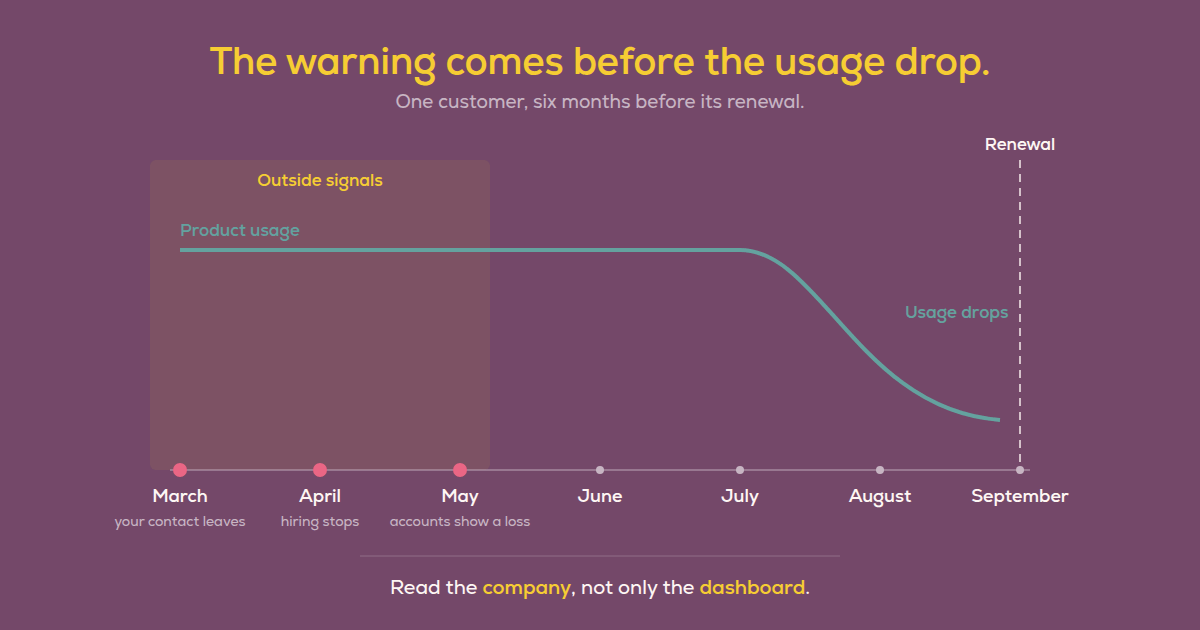
Here is an example of how it builds up. A customer renews in September. In March, the operations director who chose your product leaves for another company. In April, the company takes its open roles down. In May, it files annual accounts that show a loss. Usage has not moved yet, because the team still logs in every day. Each event alone would not worry anyone. Together, they say that the person who defended your contract is gone and that money is tight. By May, the renewal is still four months away. That is enough time to meet the new director.
A Customer at Risk Is Often Buying Again
The events in the table have something in common. They are also the events that tell you a prospect is entering a buying window. A new leader, a merger or a budget review opens a decision. For a prospect, that decision is a chance to win. For a customer, it is the moment your contract gets questioned. From the outside, a renewal at risk and a buying window often look the same. This is why signal-based selling covers the customers you already have, not only new ones.
Where the Churn Agent and Risk Agent Fit
At AxonJay, the Churn Agent watches your customer base for early churn signals. It ranks your customers by churn risk and shows the likely cause for each one. That cause is the why-now. It tells your team what changed, and what to talk about. The Risk Agent answers a different question. It watches customers for signs of financial stress and for mergers and acquisitions (M&A). That shows you late-payment risk early, and helps you put your effort into stable, growing accounts.
Some customers also get a Rising Star label. What the label means depends on what the list is for. On a churn list, it marks customers that were quiet for a long time, with nothing to flag, whose risk signals are now rising. They climb the ranking, and the label tells your team why. Both agents are part of AxonJay's Revenue Maximizers, the agents that work on existing customers. They do not contact the customer. They tell your team which customers to call and why, while the customer is still deciding.
Frequently asked questions
What are the early warning signs of churn in B2B?
Inside the product, the signs are fewer logins, fewer active users, more support tickets and a stalled rollout. Outside the product, they are the person who chose your product leaving, a hiring freeze, layoffs, an acquisition, weak annual accounts and office closures. The outside signs often come first, because most of the time they are what causes the drop in usage. Watch both. The strongest warning is several of these in a short time span.
How early can you predict churn in B2B?
There is no fixed number. It depends on your renewal cycle and on how much you can see. Usage data warns you when the customer has already started to pull back. Public business events often happen earlier, while the decision is still open. An early warning only helps if someone acts on it. So agree in advance who calls a customer when the risk goes up.
Is churn prediction for customer success or for finance?
Churn prediction is for customer success. They own the renewal, so they need to know which customers might leave, and why. Finance needs a different view: risk prediction. It shows which customers might pay late or run into financial trouble. The two share some signals, such as weak annual accounts, but they answer different questions. That is why AxonJay runs them as two agents, the Churn Agent and the Risk Agent.
Do I need product-usage data to use AxonJay for churn prediction?
No. AxonJay reads public business events, so it works without access to your product data. Your own usage data stays where it is. You can start from the customers you already have: upload your customer list, and the Churn Agent ranks them.