
Predictive vs Reactive: Why Timing the Buying Window Beats Chasing Intent
By Jean-Philippe Schepens van Thiel
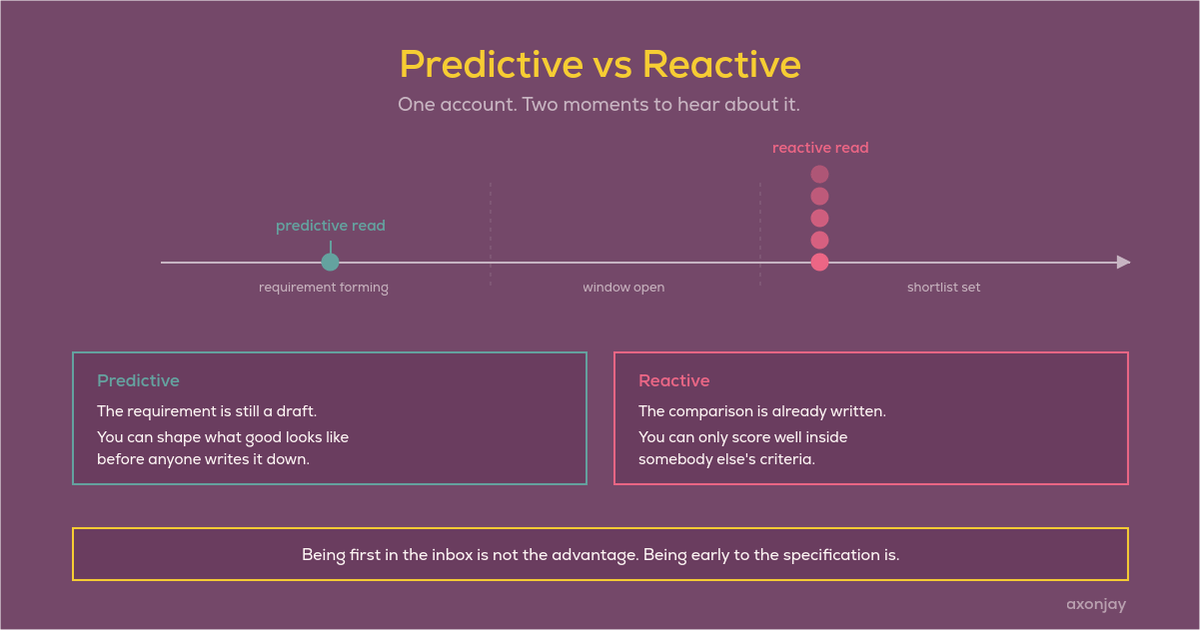
Both reads can be perfectly accurate. Only one of them arrives while the requirement is still a draft, and that is the entire difference.
Timing the buying window beats chasing intent because you reach an account while its decision is still forming rather than after it has acted. A reactive read confirms something that already happened. A predictive read flags the same account earlier, while the requirement is still open and you can still shape it.
The difference is not signal quality. Both readings can be perfectly accurate. It is where in the sequence you are standing when the reading arrives.
Reactive Reads the Past, Predictive Reads the Window
A reactive tool scores an action once it has happened. An account opens your pricing page, so you pursue it, and so does everyone else subscribed to the same feed. That is the practical intent data limitation, and it is not a data quality problem: by the time a signal is visible to you, it is visible to your whole category.
A predictive read works from the pattern that comes before the visible event. It estimates when the buying window will open instead of confirming that something has occurred.
What you want to know | Reactive | Predictive |
|---|---|---|
What does the signal mean? | A past action: a content download, a page visit | A buying window starting to open |
When do you hear about the account? | After the behavior becomes visible | Before the obvious signals surface |
Who else knows about it? | Every buyer of that data feed | Only your model, tuned by your own feedback |
What is still available to you? | Being compared on criteria somebody else set | Shaping the requirement while it is written |
The last row is the one that decides revenue. Arriving early is not about being first in the inbox. It is about arriving while the specification is still a draft.
How a Prediction Can Be Early
A forecast here is not a guess about the future. It is a reading of order and pace in the present.
Company behavior arrives in sequences: a leadership hire, then roles opening underneath it, then budget showing up. Our thirty examples of B2B buying signals make the case that no single one of those events carries timing, and that the combination does. Predictive buying signals are what you get when you read that combination for its rate rather than its content.
Two accounts can produce the identical three events. The one that produces them inside six weeks is reorganizing around a new priority. The one that spreads them over two quarters is drifting. Nothing in the events separates those accounts. The pace does, and the pace is legible before the obvious signal fires.
That is what company behavior prediction is doing, and it is the whole basis of right-time selling. You are not predicting that a company will buy. You are estimating how fast it is moving toward a decision, which is a smaller and far more tractable question.
Where Chasing Intent Runs Out
Chasing intent runs out at the moment a signal becomes visible, and the cost lands in two places.
The first is timing. A reactive read starts your clock late. Your outreach arrives in a crowded window rather than an open one, so you spend the meeting differentiating against vendors the account has already met instead of framing the problem before they did.
The shape of that is familiar. A prospect downloads a comparison guide. Within days the same account is being worked by everyone who licenses the feed that reported it, each of them opening with a version of the same message, because they all read the same event and inferred the same thing from it. Nobody in that queue is early. They are simultaneous, which is a different and much worse position.

The second is compounding. A scoring model shared across every customer reads the same behavior the same way for all of them, so however much the vendor improves it, it never gets better at your accounts in particular.
Neither cost is visible in a demo. Both show up in the second year.
The Model Is Yours
Timing is the half of this argument that everyone will eventually copy. Ownership is the half they cannot.
Most tools ship one model trained on pooled data from every customer. The Golden Moment Agent is built the other way. Your team marks each prediction with a thumbs-up or a thumbs-down, and that grade retrains a Self-Machine-Learning model that belongs to you. The rating needs no CRM integration, which matters more than it sounds: the people grading the model are the reps who actually worked the account, and they can do it the same day rather than whenever an admin next reconciles the pipeline.
What the model learns from that is not "good account" in the abstract. It is your definition of one, which is the difference between predictive lead scoring that improves and a number that merely persists.
Picture the shape of it. A shared model ranks mid-sized logistics companies highly, because across everyone's data that profile buys. Your reps have worked nine of them and marked seven thumbs-down, because in your segment those deals stall in procurement for two quarters and then renew with the incumbent. A model reading your grades stops leading with that profile and starts leading with the one your team keeps closing. A shared model cannot make that move on your behalf, because the seven accounts that wasted your quarter were somebody else's good quarter, and it has one set of weights to serve both of you.
Your model has no such conflict. Over cycles it moves toward the combinations of company behavior that open a window in your market, and away from the ones that look promising everywhere and convert nowhere.
That is what AxonJay's agents are built to do. They rank your accounts by how close each is to buying and give you the moment and the topic to approach on. Where that ranking sits in your stack, relative to your CRM, enrichment and outreach tools, is a separate question. How the Self-Machine-Learning platform is built covers the components underneath.
Frequently asked questions
What is a buying window, and how is it different from an intent signal?
A buying window is the period in which an account is actively forming a purchase decision and can still be influenced. An intent signal is one observed behavior, such as a content view or a search, that suggests interest. The window is the opportunity; the signal is a single data point inside it, and usually a late one. That difference is directional as well as one of scope: a signal points backward at something an account did, while a window describes a decision still in progress and the room you have to shape it.
When should you act on a predicted buying window?
Act when the model flags the account, not when public activity confirms it. A flag means the window is opening, and early contact is what lets you influence the requirement rather than respond to one somebody else helped write. Prioritize the flags where the window is opening fastest, because pace is the part of the prediction with a deadline attached.
Can predictive timing replace reactive intent tools?
For deciding who to contact first, yes. Reactive signals are still useful as confirmation, and there is no harm in keeping a feed you already pay for. The change worth making is which read gets to set the order of the day: let the earlier one choose the accounts, and let the visible one confirm what you already moved on.
How soon do predictions fit our accounts?
That depends on feedback rather than on elapsed time. The model adjusts as your team rates predictions, so a small number of accounts rated consistently moves it faster than a large number rated occasionally. The practical advice is to rate every flag your reps work, including the bad ones, since a thumbs-down carries as much information as a thumbs-up.