
B2B Buying Signals: A List of 30 Examples, and Why No Single One Predicts a Deal
By Jean-Philippe Schepens van Thiel
Most signal lists stop at what happened. This one adds a third column for what each signal means when it lands next to another, which is where the timing actually is.
No single buying signal predicts a deal, because each one reports a company behavior with the timing removed. A funding round confirms budget exists. It does not tell you when that budget reaches your category.
The thirty examples below are all company behavior: hiring, funding, leadership change, expansion, technology adoption. Read the first two columns and each signal looks weak. Read the third and the pattern appears. A raise after a new chief revenue officer (CRO) and an open revenue operations (RevOps) role is not the same account as a raise on its own. Sequence is the data.
The 30 signals at a glance
Here they are grouped by what the company is doing. The table further down adds what each one means on its own and next to another.
- Funding and ownership (5): a Series A or B round, a new investor, debt financing, a completed acquisition, grant or public funding.
- Leadership (5): a new chief revenue or marketing officer, a new chief financial officer, a new chief information or security officer, a founder stepping back, an executive departure.
- Hiring (5): a revenue operations role opened, a sales hiring surge, the first hire in a function, a backfilled VP role, a hiring freeze lifted.
- Technology (4): job posts naming a tool, job posts naming a migration, a website re-platform, a new integration shipped.
- Growth and expansion (7): a new office, a new market, a product launch, a warehouse or facility opening, overall headcount growth, international expansion, a partnership announced.
- Change and pressure (4): a rebrand, layoffs or restructuring, a compliance deadline approaching, a request for proposal (RFP) issued.
Buying Signals Are Company Behavior, Not a Score
Most signal tools hand you a number. Account scores 84, work it. The number feels like an answer, and it hides the thing you actually need.
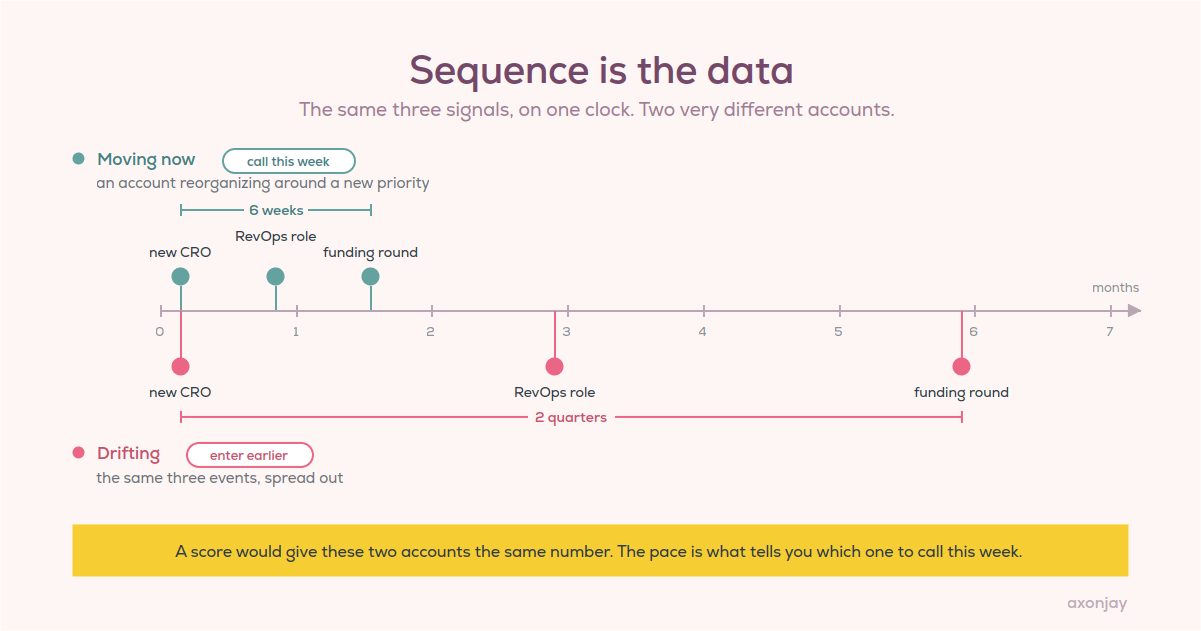
A score compresses several different observations into one figure, and in doing so it throws away what separates them. Two accounts can reach the same score by completely different routes. One raised money last quarter and has been quiet since. The other hired a CRO in March, opened two RevOps roles in April, and closed a round in May. Same score, different companies. The first has capacity. The second is reorganizing around a new priority, and only one of them is worth a call this week.
What the score removes is order. Each row in the table below is something a company did that you can see from outside: a hire, a raise, a new office, a tool named in a job post. Taken alone, each says something modest and nothing about timing. Taken in sequence, they describe a company changing shape, and the shape is what tells you whether a purchase is forming.
This is why it helps to stop thinking of these as alerts and start thinking of them as behavior. An alert is something you react to. Behavior is something you can read, and reading it is what makes the timing predictable rather than observed.
30 B2B Buying Signals, and What Each One Actually Tells You
Read this table by column, not by row. The first column names a company behavior. The second says what that behavior tells you when it arrives on its own, which is usually less than people assume. The third says what it means when it arrives next to something else.
Signal | What it suggests on its own | What it means in combination |
|---|---|---|
Series A or B round | Budget exists, timing unknown | Weeks after a new CRO, points to near-term tooling spend |
New investor added | Capital plus growth pressure | With a sales hiring surge, signals a scale mandate |
Debt financing | Working capital, not always growth | Alongside a facility opening, funds a specific build-out |
Acquisition completed | Integration work ahead | Followed by IT and RevOps hiring, flags a consolidation project |
Grant or public funding | Restricted budget | With compliance hiring, ties spend to a mandate |
New chief revenue (CRO) or marketing officer (CMO) | Priorities may reset | Right after funding, reopens the vendor shortlist |
New chief financial officer (CFO) | Cost review likely | Before renewals, signals budget scrutiny |
New chief information (CIO) or security officer (CISO) | Systems or security focus | With a compliance deadline, drives a purchase cycle |
Founder steps back | Operating model changing | With a leadership bench added, signals professionalization |
Executive departure | Direction in flux | Before a backfill, timing stays unknown |
Revenue operations (RevOps) role opened | Process gaps acknowledged | With CRM job posts, signals a stack rebuild |
Sales hiring surge | Headcount growth | After funding, points to enablement and tooling needs |
First hire in a function | New capability forming | Sequenced after expansion, flags a greenfield buy |
Backfilled VP role | Function being rebuilt | After a raise, points to fresh tooling |
Hiring freeze lifted | Spending resumes | After funding, reopens stalled deals |
Job posts naming a tool | Stack in use or planned | With migration language, signals switching |
Job posts naming a migration | Change underway | With a new CIO, times the decision |
New office opening | Geographic expansion | With local hiring, confirms a real build-out |
New market entry | Growth ambition | With a product launch, signals go-to-market spend |
Product launch | Roadmap milestone | With sales hiring, points to scaling support |
Warehouse or facility opening | Physical scale-up | With headcount growth, confirms commitment |
Headcount growth overall | Company scaling | With repeated funding, signals durable demand |
International expansion | New region, new rules | With compliance hiring, times a purchase |
Website re-platform | Tech refresh | With martech job posts, times a marketing buy |
New integration shipped | Ecosystem move | With partner hiring, signals a platform bet |
Partnership announced | Direction set | With expansion, points to co-selling needs |
Rebrand | Repositioning | With a new CMO, signals a marketing overhaul |
Layoffs or restructuring | Cost cutting | With a new CFO, points to vendor consolidation |
Compliance deadline approaching | Mandatory action | With a CISO hire, times a security purchase |
Request for proposal (RFP) issued | Active evaluation | A late signal; the sequence is already well advanced |
Why No Single Signal Predicts a Deal
Every row in that table has the same flaw. It tells you something happened. It does not tell you when the next thing will happen, and the next thing is the part you are being paid to anticipate.
Take the strongest-looking row. An RFP has been issued, which is about as close to a purchase as an observable signal gets. By the time you see it, the requirements are written, the shortlist is drawn, and someone else helped write both. The signal is unambiguous and it is also too late to shape anything. That is the trade every single signal makes: the clearer it is, the later it arrives.
Now take the weakest-looking row. A job post names a tool you integrate with. On its own that is close to noise. Put it after a new CIO and a compliance deadline and it stops being noise, because now you can see what the company is assembling and roughly how fast.
The difference is not signal quality. It is that one event carries no direction and no clock, while a sequence carries both. Direction comes from which behaviors cluster: money, then people, then systems, reads differently from people, then money. Pace comes from the gaps between them. A new CRO, a RevOps hire and a raise inside six weeks describes an account moving. The same three events spread over two quarters describes one drifting.

Scoring signals one at a time throws both away. It answers how many things fired, when the useful question is what is forming and how quickly.
From Tracking Signals to Predicting the Buying Window
Tracking and predicting are not the same discipline. When you track, you watch for signals and react once one fires. By the time a funding round is announced or a job post reaches a board, every vendor in your category can see it too. You act on public information, and you act late.
Prediction works from the order of events rather than any one of them. You model how company behavior tends to unfold before a purchase: which moves come first, which follow, and how fast. That model estimates the buying window before the obvious signals surface. AxonJay's AI-Signal Agents read those patterns, and Prospect Hunters surface the in-market accounts they point to.
The benefit is timing. You reach an account while its window is opening rather than after the market has crowded in, and you rank accounts by when they are likely to buy rather than by which event was easiest to spot. Read how the model works to see which behaviors it watches and how it weighs their order.
Frequently asked questions
Can a single signal tell you an account is in-market?
No. Hiring shows a company is scaling and funding shows budget cleared. Each one omits the date. You qualify in-market accounts by reading which signals arrive together and in what order, not by ranking one alert above the rest.
Are buying intent signals the same as buying signals?
They overlap, but they answer different questions. Buying intent data tracks what people at an account read: someone in the company downloaded a comparison guide, or its traffic turned up on a review site last week. The buying signals in this article are things the company did that anyone outside can see: it hired a CRO, opened two RevOps roles, closed a round.
The intent example tells you somebody is curious right now, but not who decides or how quickly. The behavior example tells you the company is reorganizing around something, but not who is reading what. Both are useful and neither one dates the purchase, which is why the order the events arrive in does more work than either signal on its own.
How long does a buying window stay open?
There is no fixed duration. A window opens when a pattern of company behavior starts pointing at your category and closes when the account commits to a direction or the need recedes. Read the pace rather than the count: how quickly one behavior follows another tells you more than how many have fired.
How do I act on tech stack change signals?
Treat a stack change as the middle of a sequence, not the start. A job post that names a tool, or one that mentions a migration, tells you the company is rebuilding part of its stack. On its own, it does not tell you when a decision is due. Look for what came before it, such as a new chief information officer or a compliance deadline. Then look for what should follow, such as hiring into the team that will run the new system. When you can see both, reach out about the problem the change is solving, not about the tool. When the stack change arrives alone, keep watching rather than calling.