
Account Prioritization: Knowing Which Accounts to Work Now
By Jean-Philippe Schepens van Thiel
A score set in July can still read the same in September, long after the company behind it has moved on. Why that happens, and what to rank accounts on instead.
Account prioritization is deciding which accounts your team works first. Most teams decide it with a score. A score ranks fit well. It ranks timing badly, because the number stays the same while the company behind it changes. So prioritize on two questions instead of one: which accounts fit, and which of those are entering a buying window now. For those accounts, you also want to know why they should be contacted now (the why-now).
What a Score Does Well, and Where It Stops
An account score combines what you know about a company into one number. Fit with your ideal customer profile (ICP) usually carries most of the weight. Engagement and a few buying signals are added on top, and the result sorts accounts into tiers. That is useful. Tiers decide which accounts belong on a rep's list at all. Fit changes slowly, so tiers are also the right basis for territory planning. If you do not have that list yet, start by building an ideal customer profile. AxonJay's Prospect Hunters then find the companies that match it, or that look like your best customers.
The trouble starts when the same number also has to say when. Then one score is answering two questions at once. A high score can mean a perfect fit where nothing is happening. It can also mean an average fit where something clearly is. The rep sees the same number in both cases and cannot tell them apart. This is where most sales prioritization breaks down. Signal-based selling starts by keeping fit and timing apart.
How a Score Goes Stale Over a Quarter
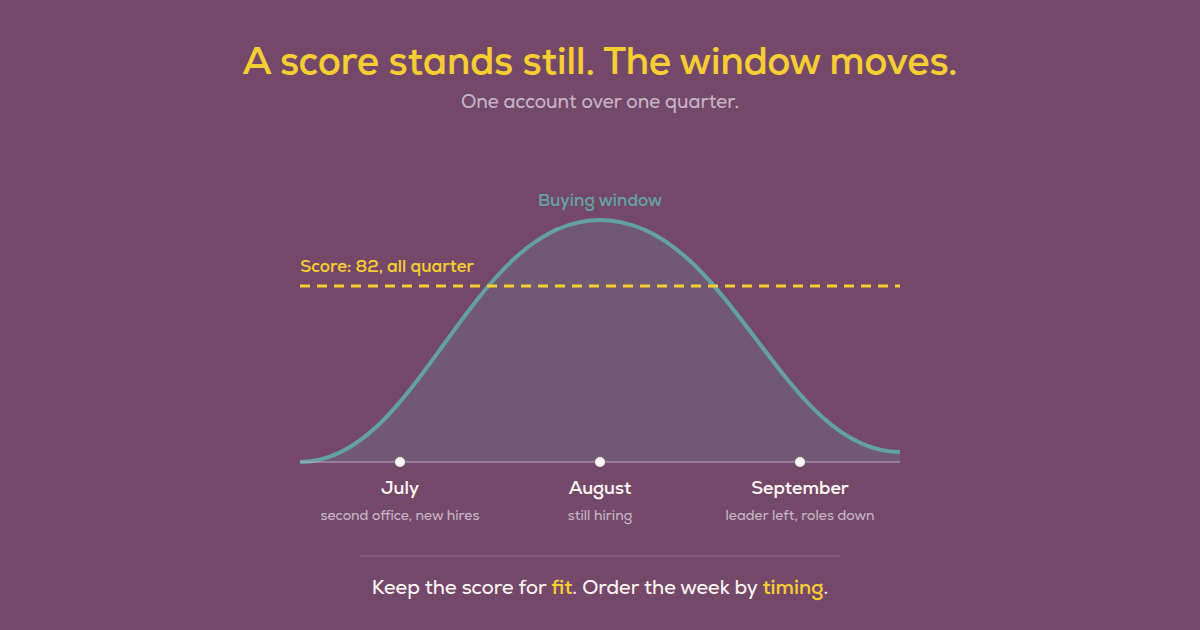
Most scores are built once and refreshed now and then. The companies they describe change every week. Here is an example of one account over three months. Its score was accurate on the day it was set.
Month | What the company did | Score | Work it now? |
|---|---|---|---|
July | Opened a second office and hired two operations leads | 82 | Yes. A buying window is opening |
August | Kept hiring into the same team | 82 | Yes. It is still in the window |
September | Its head of operations left and the open roles came down | 82 | No. The window is closing |
In September the score was still right about fit. It was wrong about timing, and nothing in the number showed it. The account stays in the top tier, so a rep keeps working it after the moment has passed. Meanwhile, accounts lower on the list that started changing in September wait their turn. Nobody made a mistake here. The score describes the company on the day it was set, and the company has moved on.
Re-Scoring Is Not the Same as Re-Learning
The usual advice is to re-score more often and to let old signals count for less than new ones. Both help, but together they fix only half of the problem. Re-scoring runs fresh data through the same formula. That catches companies that changed since the last run. It does not catch a formula that no longer matches your market. The rule for how fast old signals lose value is part of that formula too. Someone chose it, and it stays the same until someone changes it. This is true for a spreadsheet, and for most predictive lead scoring as well. The weights come from the deals that closed when the model was built. When the signals that predict a deal in your market shift, a re-scored list still ranks on the old pattern.
Re-scoring | Re-learning | |
|---|---|---|
What gets updated? | The data that goes into the formula | The formula itself |
When does it happen? | When someone runs it again | Every time your team rates an account or a deal closes |
What does it catch? | Companies that changed since the last run | Signals that stopped predicting deals in your market |
What does it miss? | Weights that no longer match how your buyers behave | Patterns your team has not rated yet |
Re-learning needs feedback. When a rep accepts or rejects an account, that decision goes back into the model. So does every deal that is won or lost. Over time, the weights move toward what works for your team. Our article on predictive and reactive signals explains how this feedback builds a model of your own. A model that learns from your team keeps up with your market. A formula that never changes does not.
Fit to Place Accounts, Timing to Order the Week
You do not have to throw the score away. Keep it for what it does well: deciding which accounts are in scope and which rep owns them. Territories stay as they are. What changes is the order inside each rep's list, and it changes every week. In-market accounts move to the top. Accounts whose moment has passed move down.
Ordering a list by timing is the job of the predictive signal layer. It watches what happens at the companies in scope, such as hiring, new offices and leadership changes. From that, it predicts when a buying window is opening and shows the why-now for each account. It does not wait for someone in the company to visit your website. By the time that happens, they have usually started looking already.
At AxonJay, the Golden Moment Agent does this for the accounts already in scope. It finds the best moment to reach out, and the topic to raise. AxonJay also gives some accounts a Rising Star label. These are companies in scope that were quiet for a long time. Their signals have now picked up, so they climb the list. The label tells the rep why. Your score still decides which accounts belong to each rep. The timing decides which of them to work now.
Frequently asked questions
What is the difference between account scoring and account prioritization?
Account scoring gives each account a number, usually built from fit, engagement and a few signals. Account prioritization is the decision about which accounts to work first this week. A score is one input to that decision, and a good one for fit. On its own it is not enough. The number does not show whether anything is happening at the company right now, or why a rep should call.
How often should you re-prioritize your accounts?
It depends on what you are changing. Which accounts a rep owns should change rarely, because moving accounts between reps can break the relationships they have built. A quarterly review of tiers is usually enough for that. The order of work inside each list is different. Companies hire, lose leaders and open offices every week. So the order should change every week too, or whenever something changes at an account.
Should account prioritization include existing customers?
Yes. Existing customers show the same kinds of signals as prospects. Those signals show when a customer is ready to expand, or when a renewal may be at risk. Rank customers and prospects by the same timing. Then a rep gets one list for new business, expansion and renewal. That is easier to work than three separate lists competing for the same week.
Do I need to replace my current account scoring to use AxonJay?
No. Keep your score for fit, tiers and territories. AxonJay adds the timing. Inside each tier, the accounts entering a buying window now move to the top, each with its why-now. You can start from the accounts you already have. Upload a list, or add companies by hand. Nothing else in your stack has to change first.