
What Is Signal-Based Selling? A 2026 Guide for B2B Revenue Teams
By Jean-Philippe Schepens van Thiel
Most guides stop at tracking signals that already fired. This one reads the discipline as a spectrum, and only the far end gives you time to act before the window opens.
Signal-based selling is a go-to-market approach that points your team's time toward accounts showing they are ready to buy. Instead of working a static list on a fixed cadence, you act on B2B buying signals as they appear and change. The goal is right-time selling: reaching an account inside its buying window rather than weeks after the moment has passed.
Most guides stop at tracking. They list reactive signals like funding rounds, job changes, and site visits, then treat that catalog as the whole discipline. It is more useful to read signal-based selling as a spectrum: tracking, then scoring, then predicting. Only the far end gives you lead time, and it has a name of its own: company behavior prediction. Tracking reads what a company has done. Company behavior prediction models what it will do next, which is a different capability rather than a faster version of the same one.
Buying signals and buyer intent are not the same thing
These two terms get used interchangeably, and the confusion costs teams money.
Buyer intent usually means one specific input: third-party data showing that people at a company are researching a topic. It is one signal type among many, and it is sold as a product.
A buying signal is any observable event that suggests an account's priorities are shifting: a funding round, a new VP of Sales, a hiring surge in a team you serve, a competitor contract approaching renewal. Intent data sits inside that set, not around it.
That is the deeper difference. Intent data models what people at a company read. Company behavior prediction models what the company itself does.
Signal-based selling is neither of those. It is the workflow: which signals you watch, how you weigh them, who acts, and how quickly. Buying intent data can feed that workflow. It cannot be the workflow.
The signal spectrum: tracking, scoring, predicting
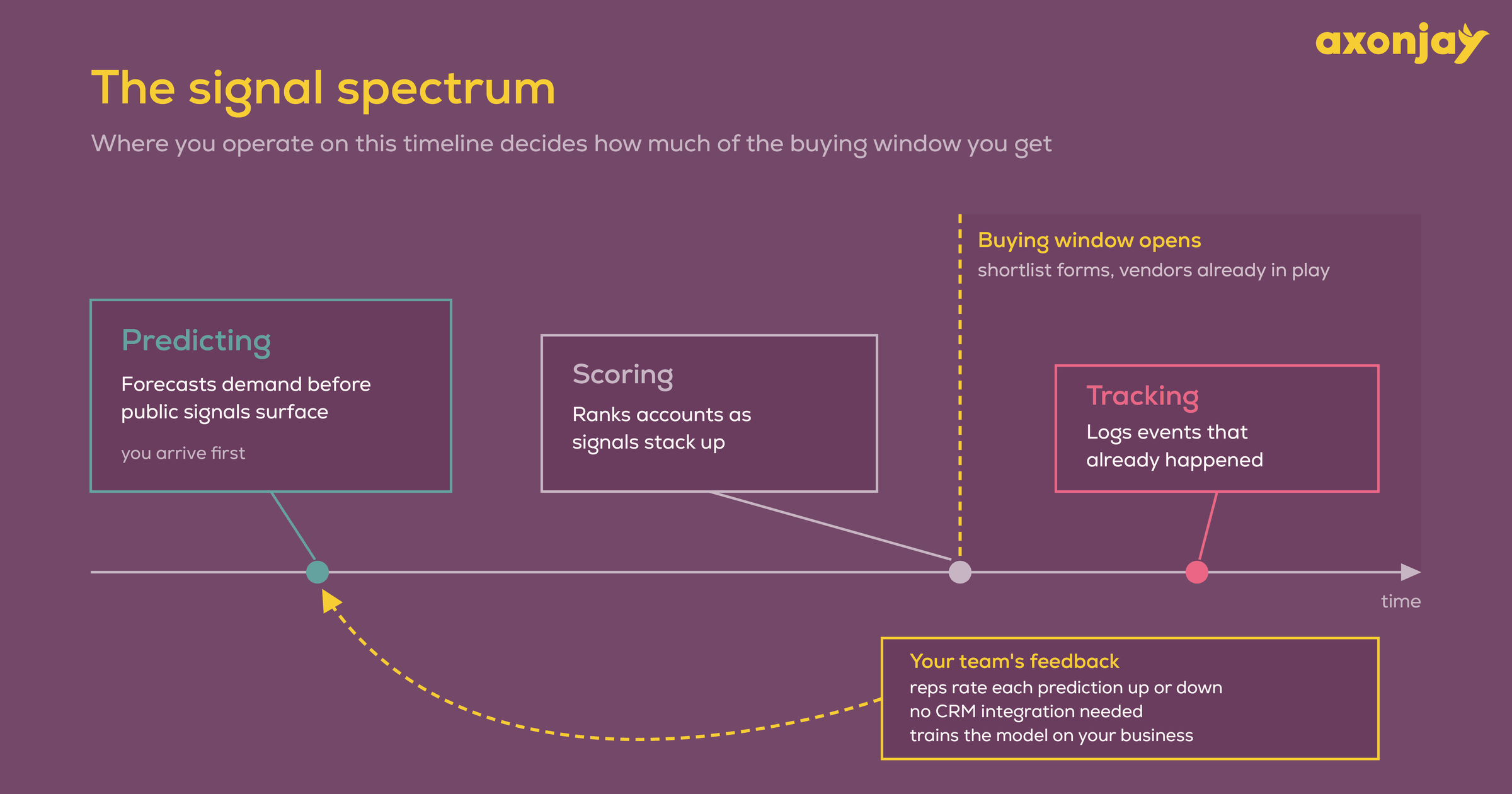
The three stages form a timeline. Each reads different data, and each reaches the account at a different point relative to the buying window. Where you operate on this timeline decides how much of the window you get.
Tracking watches for events that already happened. A funding round closes, a role changes, a contact loads your pricing page. You log the event and route it to a rep. The mechanism is simple, so the play is easy to run. The cost is timing: by the time a public event fires, in-market accounts are often already talking to vendors.
Scoring adds weight to the signals you already collect. You combine fit with recent activity, then rank accounts by how strong and recent the evidence is. Ranking tells you where to start, but it still waits for signals to surface. You act as the window opens, not before.
Predicting goes deeper than tracking what an account did. It models company behavior: hiring, expansion, funding, leadership change, tech adoption. It reads the patterns that come before demand, then discovers and highlights predictive buying signals before the public ones surface. The forecast lands early, so you can plan outreach while the account is still forming its shortlist. AxonJay's AI-Signal Agents sit at this end of the spectrum.
Stage | What it detects | When it fires | Risk of acting too late |
|---|---|---|---|
Tracking | Past events: funding rounds, job changes, site visits | After the window opens | High |
Scoring | Clusters of signals ranked by fit and recency | As the window opens | Moderate |
Predicting | Forecast demand before public signals surface | Before the window opens | Low |

Move left to right and you trade certainty for lead time. Tracking is accurate but late. Predicting fires earlier, so you can reach the account while the window is still open. Many teams already run tracking and scoring well. The gap is prediction.
Why timing beats volume
The case against high-volume outbound is not that it never works. It is that volume treats every account as equally ready, which is never true.
Run the logic on your own numbers. Take the accounts you closed last year and ask how many were in an active buying window when you first reached them. Then ask what share of last quarter's outbound went to accounts with no reason to buy at all. The second number is usually the uncomfortable one, and it is the real cost of working a list rather than a signal.
Timing changes the economics in three ways. You spend fewer touches per meeting, because the account already has a reason to answer. Your message writes itself, because the signal tells you what changed. And you arrive before the shortlist forms, which is the only point at which a new vendor can still shape the requirements.
The stage most teams miss: a model that learns your business
There is a fourth step past predicting, and it is the one that decides whether prediction keeps working.
A prediction model has to be trained on something, and platforms in this category answer that differently. Some run a shared model across their whole customer base, so an account carries broadly the same score whoever is looking at it. Others build a model for you once, at onboarding, and leave it there. Both are worth telling apart from a third option: a model that keeps learning from what your team does after that.
The distinction matters. A model trained on the market in general knows nothing about which accounts your team is winning now. Nor does one trained on your business as it looked the day you signed.
AxonJay calls its approach the Self-Machine-Learning Platform™. Reps rate each prediction with a thumbs up or a thumbs down, and that rating trains the model. Two things follow from doing it that way. The judgment comes from the people actually working the accounts, not from a data pipeline. And because CRM integration isn't required to start, the model begins adapting in your first week. It connects to your CRM and the rest of your stack whenever you're ready.
A static model scores the way it did on day one. A model trained on your feedback has learned, by the time you are a year in, which of your signals matter and which are noise. So when you evaluate any platform here, ask two things: does it learn from our outcomes, and what should we expect accuracy to look like after a year of use?
Signals across the full funnel, not just new logos
Most teams point signal-based selling at one job, which is finding new-logo accounts. That leaves the majority of their revenue base unwatched.
Start with expansion. When an account adds headcount to a team you serve, opens a new use case, or crosses a usage threshold, it has entered a buying window for more. Read that early and you arrive with the right offer while the need is live.
Retention works the other way. A departing champion, a drop in active users, or a stalled rollout points toward churn risk. Those are not buying signals, they are leaving signals, and catching them early is the difference between a renewal conversation and a save attempt.
The plays differ by stage, but the method does not:
Funnel stage | The signal that matters | The play |
|---|---|---|
New logo | A predicted window, before public signals appear | Reach out early with a fit-specific point of view |
Expansion | Usage pressing against the limits of the current plan | Present the next tier using the account's own usage |
Renewal risk | Adoption flattening as the renewal date approaches | Run a value review and confirm the renewal path |
Churn risk | Logins falling and the sponsor going quiet | Launch a save play with the account team |
That makes it a full-funnel motion. One shared signal layer feeds sales, customer success, and renewals, so no team works from a stale list. Run it across the full funnel and one motion covers three outcomes: land the accounts entering a window, grow the ones you have, hold the ones at risk. The Golden Moment Agent forecasts the point at which each account is most likely to move.
Turning signals into action
A signal nobody acts on is a report. Four rules turn it into a motion.
Give every signal an owner. Sales, customer success, or renewals, decided in advance by signal type. Unowned alerts are the most common reason a rollout quietly dies.
Define the play before the signal fires. Each signal maps to one response: a specific email, a relevant case study, a call. Reps should never have to invent a play under time pressure.
Set a suppression rule. No rep should work a duplicate or a stale signal. Decide how long a signal stays actionable and enforce it.
Feed the outcome back. Log which signals produced meetings and which did not, and return that to whatever does your scoring or prediction. This is the step that separates a system that improves from one that decays.
A maturity check for your team
Work down this list and stop at the first item you cannot answer confidently. That is where your next quarter's work is.
- Can you name the three signals that most often preceded your last ten closed-won deals?
- Does a signal reach a rep the same day it fires?
- Does every signal type have a named owner and a defined play?
- Do you measure conversion by signal type, not just in aggregate?
- Does anything in your stack forecast a buying window, or does all of it report events that already happened?
- Does your scoring improve from your team's feedback, or does it score the same way it did a year ago?
If you stall in the first four, the fix is process, not tooling. Items five and six are where the timing advantage itself comes from.
Frequently asked questions
How is signal-based selling different from intent data?
Intent data is one input. Signal-based selling is the full workflow of watching, weighing, and acting on many signal types across the funnel. You can buy intent data and still have no signal motion.
Do I need predictive AI to start?
No. Most teams begin with tracking and scoring using data they already hold, then add prediction to gain lead time. Starting with tracking is fine. Stopping there is the problem.
Does it work for retention, not just new business?
Yes. The same signal layer that flags an account entering a buying window also flags one drifting toward churn. That is why it belongs to customer success as much as to sales.
How long before it shows results?
Reply rates move first, because relevance improves as soon as outreach follows a real signal. Pipeline moves later, because accounts you reach earlier still take time to reach a decision. Measure the two separately, or the early read will mislead you in one direction and then the other.