
How AI Sales Agents Fit Into Your Go-to-Market Tech Stack
By Jean-Philippe Schepens van Thiel
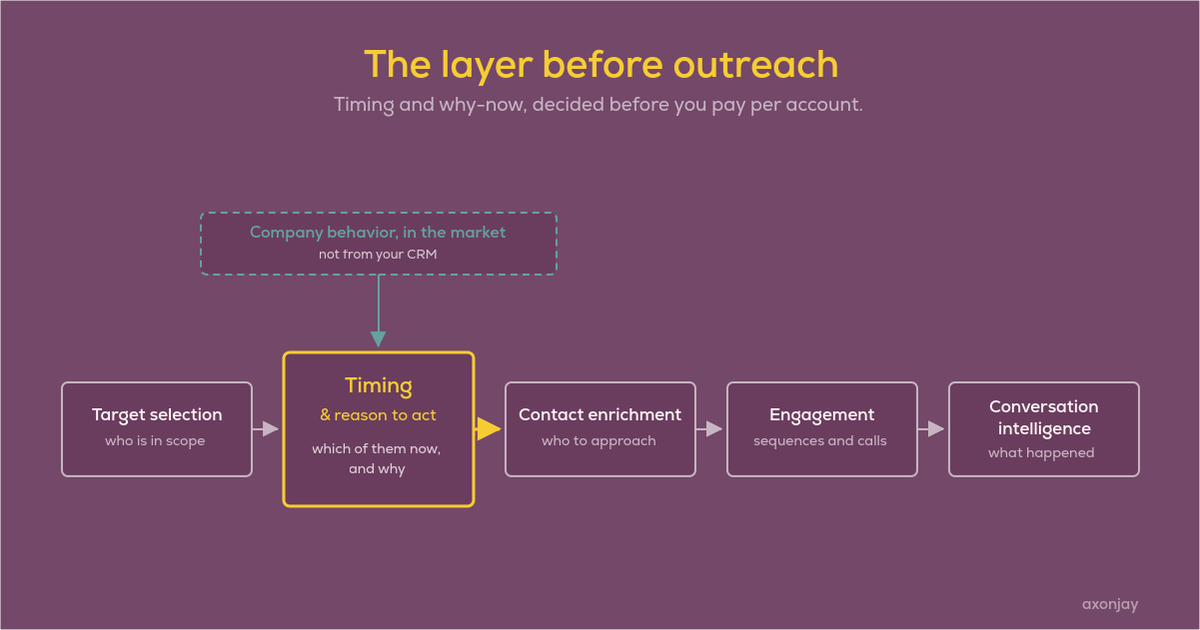
The layer before outreach decides which account deserves attention now, and why. Where it sits in the chain, and what it makes cheaper downstream.
AI sales agents sit in the layer before outreach. They decide which account deserves attention now, and why. Then they hand that decision to the tools that do the contacting. Nothing you run today comes out. For revenue operations (RevOps), this is a stack enhancer rather than a rip-and-replace. What changes is how much work everything downstream has to do.
Where the Signal Layer Sits
A go-to-market stack is a chain of jobs, and the jobs run in an order. Target selection decides which companies are in scope at all. The predictive signal layer then decides which of those deserve attention this week, and why they should be contacted now (the why-now). Contact enrichment supplies the roles and details. Engagement runs the sequences and the calls. Conversation intelligence reads what happened afterwards.
Job in the chain | The question it answers | What it produces |
|---|---|---|
Target selection | Which companies are in scope? | A universe of accounts worth watching |
Timing and why-now | Which of them now, and why? | A ranked list with the evidence behind each |
Contact enrichment | Who do we approach, and how? | People, roles and details |
Engagement | What gets sent, in what order? | Sequences, calls, replies |
Conversation intelligence | What happened? | Deal analysis, after the conversation starts |
One thing the chain hides. Drawn left to right it looks like it is only about winning new customers, and it is not. The same layer runs on accounts you already serve. There the question is not whether to approach. It is whether to expand, renew, or step in before someone leaves. The behavior it reads is the same. Only what you do about it changes.
The position in the chain is the whole point. Put the signal layer after enrichment and it only reorders a list someone already paid to build. Put it after engagement and it is a report.
Your CRM sits across all of this as the system of record. The signal layer is not trying to replace it, or to keep a rival copy. It also does not have to be wired into it before it is useful. The ranking and its why-now stand on their own, so you can judge whether the calls are any good before any integration work is scheduled.
Why That Order Narrows Focus and Cost
Enrichment and outreach are metered. You pay per record enriched, per credit spent, per token burned by whatever writes the message. Those costs scale with the number of accounts you push through them.
Target selection does not narrow much. It gives you every account that could plausibly be worth something, which on most teams is thousands of companies. If that whole universe flows into enrichment, you are paying to enrich a list that is mostly not in market this quarter.
The signal layer narrows it before the metered tools run. Enrichment gets a shortlist. Engagement gets a queue with the why-now attached to every row. The same budget covers a fraction of the accounts, and those accounts are the ones with something happening.
That is two savings at once. You spend less, because fewer records go through the meter. You convert more, because the records that do go through were chosen on timing rather than on fit alone.
What Changes at Each Layer
Nothing is removed. Each layer keeps doing its own job. What changes is the input it gets.
Layer | Without a signal layer | With one |
|---|---|---|
Target selection | Produces a universe nobody can work through | The same universe, now an input rather than a to-do list |
Contact enrichment | Enrich everything, or guess what to enrich | Enrich a shortlist chosen on timing |
Engagement | Work the list in whatever order it arrived | Work a queue ordered by timing, with the why-now on every row |
CRM | Morning export, ad hoc scoring, manual triage | Still the system of record, with the ranking alongside it |

The second row is the one people get wrong. Enrichment is not competing with the signal layer. It runs after it, on a shorter list.
Fit, Timing and Why-Now
These three get described as one thing. They sit close enough together that it is worth pulling them apart. Fit is a lookalike problem. It looks for companies that resemble your best customers. Fit is a stable property, and it does not tell you when. Timing reads company behavior in the market. Hiring, funding, leadership change, expansion, technology adoption. Our thirty examples of B2B buying signals work through what each one means alone and in combination. Reading those combinations for pace is what estimates when a buying window opens, and the explanation of that estimate is the why-now. Timing without a why-now is a number your team has to take on trust. Timing with one is a sentence a rep can open a call with.
AxonJay's AI-Signal Agents run the timing in two ways. Golden Moment works on accounts already in your scope. It says which of them is entering a window now. That is the everyday one, and it is what reorders Monday morning. Rising Star is a label, and it exists because a position alone does not tell you what changed. These are companies that produced very little for a long time, so nobody looked at them. When their signal rate accelerates they climb the list. The label says why they climbed: they were quiet, and they are not any more. Their fit never changed. Their behavior did, and that is the part a list ranked on fit cannot show you. Both arrive with the why-now attached, and that is what decides whether anyone acts. A rep will work a row that reads like this:
Novaline Logistics. Surfaced because a new revenue lead arrived seven weeks ago, two operations roles opened last month, and a funding round closed on Tuesday. Approach on capacity planning.
A rep will ignore a row that says 87. So put the ranked accounts where reps will actually see them, and keep the why-now attached when you do.
The model behind it adapts two ways. Your team's good and bad calls teach it your definition of a strong account. Where you have won and lost history, it learns from that too. How the platform works covers what sits underneath. The prediction itself does not come from your pipeline. That is why it can raise an account nobody has looked at in a year.
Frequently asked questions
Do AI sales agents replace my CRM?
No. A vendor who says otherwise is selling you a second system of record you will regret. The CRM keeps accounts, contacts and deal history, and it carries on doing that. The signal layer produces a ranked account and its why-now, which you can work alongside the CRM without wiring the two together first. What goes away is the manual work around it:
- the morning export
- the ad hoc scoring
- the timing guesswork
Do I need the rest of the stack before a signal layer is useful?
No. The chain above can read like a shopping list, so it is worth saying plainly: AxonJay is broader than the timing layer. It will take a universe however you want to give it one. Define an ICP, upload your own list, add companies by hand, or build lookalikes from your best customers. It enriches the company data itself, from official registers and the open web, so firmographics arrive with the account rather than being bought separately. The timing then runs on top, and there is an assistant you can ask in plain language.
Note what that leaves, and why. Finding the right people is covered: the assistant will identify the relevant contacts at an account when you ask it. Bulk contact data still comes from an enrichment tool if you run one. Sending is the deliberate gap. A layer whose whole argument is that timing beats volume is an odd place to bolt on a bigger sending machine. So the message stays with your outreach tool, or with a rep and an inbox. If you already run enrichment and sales automation, they keep their jobs and get a shorter list. If you do not, nothing here blocks you from starting. That boundary is the subject of a separate article on what an AI SDR can and cannot decide for you.
How is a predictive signal layer different from intent data?
Intent data reports activity that has already happened. It reaches you at the same moment it reaches everyone else who buys that feed. A signal layer reads the pattern that comes before the visible event and estimates when the buying window opens. The account arrives while the requirement is still being written. One is a record, the other is a forecast, and our piece on predictive versus reactive reads works through the difference in full.
What does the layer actually do, and what does it not do?
This article is about the layer, which is worth separating from the platform around it. The layer does three things: it watches company behavior, ranks accounts on timing, and shows the why-now behind each ranking. It does not define your ideal customer profile, which is target selection and sits upstream. It does not write or send anything, which is engagement and sits downstream. And it does not hold your data, which is what the CRM is for. AxonJay the platform is wider and does cover target selection, as the previous answer says.
That also answers the word agentic. Agentic AI executes autonomous tasks, and today that scope is narrow across the whole category. Ranking accounts and explaining the ranking is real work and it is bounded work.