
How to Build an Ideal Customer Profile That Tightens With Every Deal
By Jean-Philippe Schepens van Thiel
Most ideal customer profiles are right for a quarter and wrong a year later. Why yours goes stale, what to keep in it, and why fit still cannot tell you when to call.
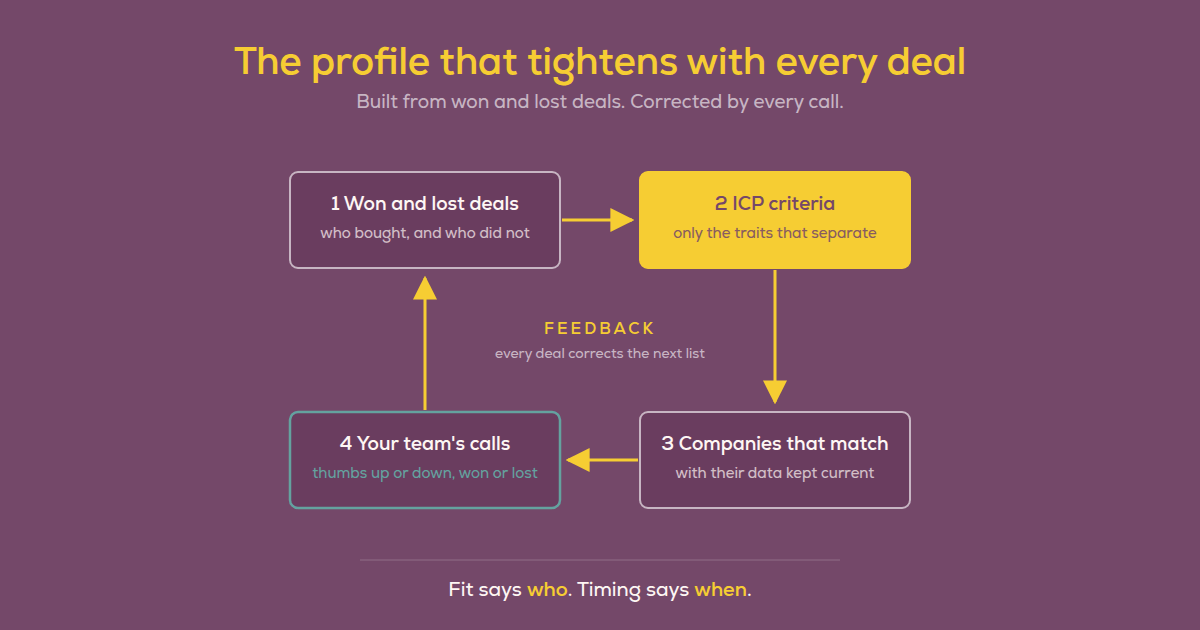
Build your ideal customer profile (ICP) from the deals you have already won, keep only the traits that also separate them from the deals you lost, and correct it every time a new deal closes. Built that way, a profile is a filter you keep adjusting rather than a document you finish. It tells you which companies deserve a place on your list. It does not tell you which of them to call this week, and keeping those two questions apart is most of what makes a profile useful.
Why a Written ICP Stops Working
Most teams write the profile once. They agree on an industry, a size band and a region, put it on a slide, and move on. The trouble is that it ages in two separate ways. The definition drifts. The kind of company that buys from you changes as your product and your market change, so the slide keeps describing last year's customers. The companies drift as well. A business that matched on headcount, ownership or industry a year ago may not match today. Similarly, one that did not match in the past may match now. A profile can be right and still point at the wrong list.
That is why an ideal customer profile template rarely fixes the problem on its own. A template gives you the fields to fill in. It cannot tell you which answers are true for your business, and it has no way of noticing when they stop being true. Those answers have to come from your own won and lost deals, and they have to be checked again as new deals arrive.
Build It From Won and Lost Deals
You can do this in a spreadsheet, and it is worth doing by hand at least once, because it shows you what your data can and cannot support. Start with the accounts you won and kept. Then pull the accounts you lost, and the ones that stalled. Record the same facts for both groups: the firmographics, such as industry, company size, region and ownership, plus any other trait your team already trusts.
Step | What you do | What you end up with |
|---|---|---|
1. Pull both sides | Export the accounts you won and the accounts you lost | Two lists you can compare |
2. Record the same facts | Industry, size, region, ownership and any trait your team trusts | One row per account, same columns |
3. Keep what separates | Drop any trait that is as common in losses as in wins | A short set of ICP criteria |
4. Write the exclusions | Note the traits that show up mostly in losses | Rules for who is not a fit |
5. Turn it into a filter | Apply the criteria and the exclusions to your market | A list of companies worth watching |
6. Recheck as deals close | Test the criteria again each time a batch of deals closes | A profile that keeps up |
Step three is where most profiles go wrong. It is easy to describe your customers and much harder to find what predicts them. If most of your wins are mid-sized companies but so are most of your losses, company size describes your market without telling you who buys. Keep a criterion only when it is clearly more common among wins than losses. The list gets shorter, and every line on it earns its place. Step four is skipped even more often, and it can save the most time. A written rule for who is not a fit stops reps working accounts that were never going to close.
Trait (an example) | In your won deals | In your lost deals | Keep it? |
|---|---|---|---|
50 to 500 employees | Most of them | Most of them too | No. It describes both |
Already runs a CRM | Almost all | Almost all | No. Everyone has one |
Sells in more than one country | Often | Sometimes | Test it on the next batch |
Brought in a new sales leader in the last year | Often | Rarely | Yes, but as a signal, not a criterion |
Look at the last row. It separates wins from losses, but it is not a firmographic trait. It is something a company did, and it will not stay true: a leader hired last year is old news a year from now. Traits like that are buying signals, and they belong in your timing rather than in your profile. Keep your ICP criteria to the things that describe what a company is.
Keeping It True With Feedback
The sequence above gives you a good first version. What keeps it good is feedback, and that feedback comes from two places. The first is your team's judgment: the accounts reps accept as worth working, and the ones they reject. The second is the result: which of those accounts you went on to win, and which you lost. Judgment tells you quickly when a list feels wrong. Outcomes tell you, more slowly, whether that judgment was right. A profile that takes in both gets closer to your real buyers with every cycle, instead of aging on the slide it was written on.
Doing this by hand means exporting, rescoring and rerouting every time. ICP Hunter takes over that part. It scans the market for companies that match your profile by location, industry and company size, ranks them from most to least likely to buy, and learns from your team's thumbs-up and thumbs-down on each one. Where you have won and lost history, the model learns from that as well. The company data behind every match is enriched from official registers and the open web, so the facts stay current as companies change. If your strongest pattern is simply your best few customers, you can start from them instead and build lookalike companies, each scored by how closely it resembles them. Either route ends in a ranked list that improves as your team uses it. How the platform works covers what sits underneath.
Fit Tells You Who, Not When
A tight profile still leaves you a long list, and that is where the second question starts. Take two companies that match every one of your ICP criteria. One is hiring into the team that would use your product and has just opened a new office. The other has frozen hiring and taken its open roles down. On your profile they look identical. On your calendar they could not be further apart. Fit describes who a company is. It says nothing about what the company is about to do, so a list ranked on fit alone sends reps to the second company as often as the first.
Separating those two is the job of the predictive signal layer, which sits directly after target selection in a go-to-market stack. Your profile decides which companies are in scope. The signal layer reads what those companies are doing, estimates when a buying window is opening, and shows why they should be contacted now (the why-now). Your in-market accounts are the ones where both answers line up: they fit, and something is happening. That is what signal-based selling means in practice: fit decides who is in scope, and timing decides who to call.
AxonJay runs the timing in two ways. Golden Moment works on the companies already in scope and flags the ones entering a buying window now. Rising Star is a label on companies in your scope that produced very few signals for a long time and whose signals have now picked up. They climb the ranking, and the label tells you why: they were quiet, and they are not any more. Their fit never changed. Their behavior did, and a profile on its own cannot show you that. The same feedback that keeps your profile honest trains the timing too, because the model learns from your team's good and bad calls and from your won and lost deals.
Frequently asked questions
What is the difference between an ideal customer profile and a buyer persona?
An ideal customer profile describes a company: its industry, size, region, ownership and the other traits your best customers share. A buyer persona describes a person inside that company: their role, what they care about and what they need to hear. You need the profile first, because it decides which companies are worth anyone's time. Personas come after, once you know which company you are approaching. AxonJay's assistant helps with that second step by identifying the relevant contacts at an account when you ask it.
How often should you update an ideal customer profile?
More often than most teams do. At the very least, recheck your ICP criteria whenever a new batch of deals closes, won or lost, because each one either confirms a criterion or weakens it. If you are doing it by hand, a quarterly review is a sensible floor. The better answer is to stop treating it as a review at all. When your team's accept and reject calls and your deal outcomes feed back into the ranking as they happen, the profile keeps up without anyone scheduling a meeting.
Does an ideal customer profile apply to existing customers?
Yes, and it is one of the most useful places to use one. The criteria that describe your best new customers also show which existing customers look like your best accounts and still have room to grow. Apply the same profile to your customer base and you get an expansion list, not only a prospecting list. Timing matters there as much as anywhere. A customer that fits perfectly but has just announced cost cuts is not ready for a bigger conversation, and one that is expanding into a new market might be.
Do I need a finished ICP before AxonJay is useful?
No. A written profile helps, but it is only one way in. AxonJay takes a list however you want to give it: define an ideal customer profile, upload a list of companies you already track, add companies by hand, or build lookalikes from your best customers. It enriches the company data itself from official registers and the open web, so the firmographics arrive with each account rather than being bought separately. You can sharpen the profile after you start, using exactly the feedback described above.