
Pre-Intent: What Comes Before Intent Data
By Jean-Philippe Schepens van Thiel
The gap between a company fitting your profile and a company showing up in an intent feed is wider than it looks. What sits in it, the three tests for reading it, and where the reading stops being reliable.
Pre-intent is the pattern a company produces while a requirement is still forming, before it starts researching vendors. Buyer intent data reports that a company has begun looking. Pre-intent describes the stretch before that, when the need already exists inside the company but has not yet turned into a search, a download or a request for pricing.
Working that stretch on purpose is pre-intent selling. A pre-intent signal passes three tests: it is observable from outside the company, it comes before category research rather than reporting it, and it is read as a sequence for its pace rather than as a single event. Pre-intent is not fit, not faster intent data, not a prediction that a company will buy, and not private information. The case for working early rather than late is already made in our piece on predictive versus reactive buying signals.
Where Pre-Intent Sits
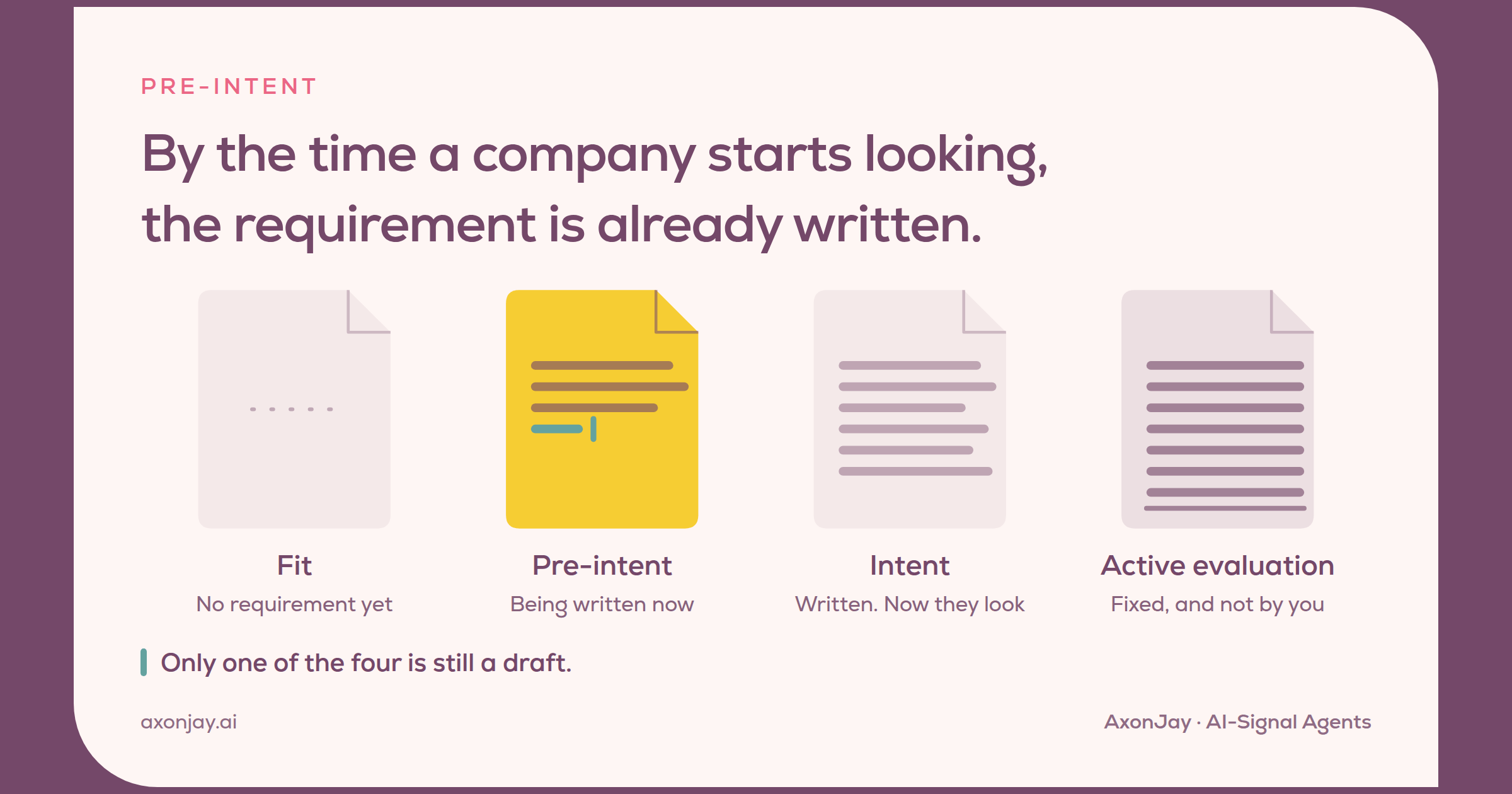
Pre-intent is a layer, not a tactic, and it is easiest to define by what sits on either side of it. Fit describes a company's standing properties and changes slowly. Intent describes category research and arrives once the company is already moving. Pre-intent is the gap between them, and it is wider than it sounds, because a requirement can sit inside a company for a long time before anybody there types the name of a product category into a search box.
It also works differently from the layer above it. Buyer intent is usually a trigger: one event, read on its own, that says a company has started looking. Pre-intent is never one event. It is a set of signals whose order, pace and content have to be read together, which is why two companies producing the same facts can mean different things, and why the reading is harder to copy.
Layer | What you can observe from outside | The question it answers |
|---|---|---|
Fit | Industry, size, geography, the process the company runs today | Is this company worth our team's time at all? |
Pre-intent | Structural moves that make a requirement likely: a role opened, a site added, an accreditation extended, a leader arriving | Is a requirement forming here? |
Intent | Category research: a comparison page read, a webinar attended, pricing requested | Has the company started looking? |
Active evaluation | A published tender, a shortlist, reference calls | Are we being measured against criteria a competitor helped shape? |
Read the table downward and the cost of starting at the third row is plain. By the time a company produces intent, the requirement it is researching has already been written down, and whoever was in the room while it was drafted had the most say in what it contains. Pre-intent is the only layer in that table where the specification is still open and there is already a reason to make contact.
The Three Tests for a Pre-Intent Signal
The category needs edges or it collects everything, so here are the three tests. A signal has to pass all three.
It is observable from outside the company. Anyone willing to look can see a job posting, a planning application, a lease, a funding round, a certification scope, a new name on a leadership page. If a fact requires somebody inside the company to hand it to you, it is a tip rather than a signal: valuable, unrepeatable, and impossible to run as a process. This test is stricter than it first reads, and it is the one that makes the layer repeatable rather than anecdotal. It also keeps the whole layer at company level, where the facts are published rather than personal.
It precedes category research rather than reporting it. A company that has opened a role to run a process it does not yet have has told you something before it told the market. A company reading a buyer's guide has told the market first, and told it to everybody subscribed to the same feed. The ordering is the whole definition: if the event you are reading is the company looking for vendors, you are in the intent layer, however fast the alert reached you.
It carries pace, not just occurrence. One event on its own is an anecdote. Two companies can produce an identical set of three events, and the one that produces them in quick succession has reorganized around a new priority while the one that produces them across a year has not. Nothing in the events themselves separates those companies, so a pre-intent signal is never a single fact. It is a sequence read for its rate, and the rate is what carries the timing. What the events are actually about is what tells you the timing is pointed anywhere near what you sell, and the worked example below turns on exactly that.
Four Things Pre-Intent Is Not
It is not fit. A company can match your ideal customer profile (ICP) perfectly for years without a requirement forming in it. Fit tells you which companies belong in scope and is stable by design, which is exactly why it cannot tell you which of them to call this week.
It is not intent data delivered faster. Speed is not the difference. A reactive read of a late event is still a late read, no matter how quickly it arrives, because the thing being read happened after the requirement was set. Pre-intent works on different events, not on the same events sooner.
It is not a prediction that a company will buy from you. Nothing in this layer says who wins. A requirement can form and then stall for a year, go to an incumbent, or get solved internally with no purchase at all. A pre-intent reading says a window is opening. It does not say who walks through it.
It is not private information. Everything in this layer is published, filed or posted by the company itself. That boundary is deliberate and it is also what keeps the whole approach at company level rather than person level.
What It Looks Like in One Account
Here is an example, and it is only an example. A network of environmental testing laboratories extends its accreditation scope to cover a new class of analysis. Six weeks later it posts two openings for method development chemists at one site. A month after that it signs a lease on a fourth location. No single one of those three facts is about buying anything. Together, and at that pace, they say the company has committed to running a kind of work it was not running before, and that the systems and suppliers for that work are being chosen now.
A team working the intent layer meets this account later, when somebody there finally reads a comparison guide, by which point the requirement has a shape and probably a preferred answer. A team working pre-intent arrives while the chemists are being hired, which is when the question is still what to do rather than who to buy it from.
The same example shows how a pre-intent read goes wrong, and it is worth knowing before you rely on one. A company can extend an accreditation, hire for it and add a site because it won a single contract that required all three, with no intention of changing anything else it runs. From outside the sequence looks identical, and the pace is real. That is the limit worth knowing: pace alone reads commitment, not purpose. What separates the two is not more data but what the signals actually say. An accreditation extended in the area you serve, a role opened for work the company does not yet do and a site taken in a new market point somewhere specific; three busy months around a single won contract do not. So a pre-intent reading is content and timing together, and it is confirmed or disproven by what the company does over the following weeks.
Where This Fits in Practice
At AxonJay, this is the layer the product reads. The predictive signal layer works from the published record of what companies do, and it estimates when a requirement is forming instead of confirming that research has started. What it hands a rep is timing and the reason they should be contacted now (the why-now), on accounts the team had already put in scope. The output is a forecast of the buying window, not an alert that something has happened. Our AI-Signal Agents are the individual readings built on it, each one doing a single job: finding profile matches, spotting companies that resemble your best customers, flagging the moment to reach out, watching for risk.
What the team does with that is their call, and reaching a company while the requirement is still a draft is the point. Where the layer sits beside the tools you already run is its own subject, covered in AI sales agents and the tech stack.
The gain customers report takes two shapes. Some find considerably more highly prospective companies than they were finding before. Others reach the same result with a smaller sales team, because the accounts their reps open are the ones already in motion. More of their results and testimonials are on our site.
Pre-intent is not only for companies you have never sold to. A customer adding a site, a function or a leader is forming a requirement in exactly the way a prospect does, which is why the same reading drives retention and expansion: see B2B churn prediction.
Frequently asked questions
What is pre-intent?
Pre-intent is the observable pattern a company produces while a requirement is still forming, before it begins researching vendors. It sits between fit, which describes a company's standing properties, and intent, which reports that the company has started looking. Every pre-intent signal is something the company itself published, posted or filed.
How is pre-intent different from buyer intent data?
Buyer intent data reports category research: a vendor comparison read, a demo requested, a shortlist taking shape. Those events happen after the requirement has been framed, and they are visible to everyone who licenses the same feed. Pre-intent is not the same feed moved earlier: a trigger can be read straight off one event, while a pre-intent reading only exists once several signals are weighed together for what they say and how fast they arrive. Pre-intent reads an earlier and different set of events, such as hiring, premises, filings and leadership changes, and it reads them as a sequence rather than one at a time.
What are examples of pre-intent signals?
A role opened for work the company does not yet do, a new site or lease, a certification or accreditation scope extended, a funding round, a leader arriving in the function that would own the problem. On their own each is just a fact about a company. The signal is several of them arriving close together in a pattern that fits the companies you sell to, because the pace and the content together indicate a decision forming rather than a company going about its year.
What is pre-intent selling?
Pre-intent selling means working accounts while a requirement is still forming, before the company starts researching vendors. Instead of reacting to category research, a team reads the company's own public moves, such as roles opened, sites added and leaders arriving, and gets in touch while the specification is still open.
Can you work pre-intent without buying intent data?
Yes, and the two answer different questions, so neither replaces the other. Pre-intent tells you which in-scope accounts are forming a requirement and roughly when. Intent data confirms that an account has started shopping, which is useful for a deal already moving and late for one that is not.