
Buying Signals Software: A 12-Point Checklist for Choosing a Platform
By Jean-Philippe Schepens van Thiel
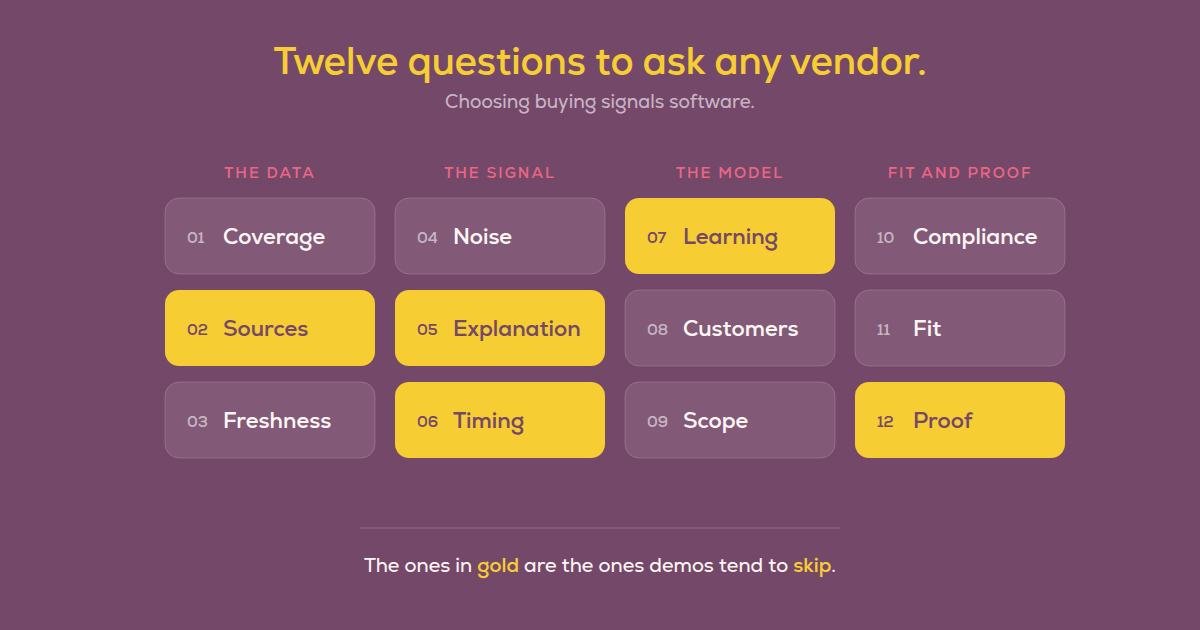
A demo answers the easy questions. These are the twelve to ask instead, and the five that decide whether the platform works on your own market.
Buying signals software watches companies for events that suggest they are moving toward a purchase, and tells your team which accounts to work and why. Most buying guides compare tools on coverage and integrations. Those matter, but they are the easy part to check in a demo. This checklist adds five questions that demos tend to skip. Where does the data come from? Does each alert explain itself? Does the platform predict, or only react? Does the model learn from your own results? And how will you know, early on, whether it is working? It has twelve points in four groups, each with a question you can put to any vendor.
Point | The question to ask any vendor |
|---|---|
1. Coverage | Which kinds of events do you watch, and for which countries? |
2. Sources | Where does each signal come from, and can I see the source? |
3. Freshness | How long after an event does it reach my team? |
4. Noise | How many flagged accounts does a team like mine actually work? |
5. Explanation | Does every account come with the reason it was flagged? |
6. Timing | Do you forecast a buying window, or alert me after an event? |
7. Learning | Does the model learn from my team's decisions and my deals? |
8. Customers | Does it work on my existing customers as well as prospects? |
9. Scope | How do I tell it which companies to watch? |
10. Compliance | Is the data about companies, or about people? |
11. Fit | What does it add to my stack, and how is it priced? |
12. Proof | How will we know, early on, whether it is working? |
The Data: Coverage, Sources and Freshness
1. Coverage. Start with what the platform watches. Some tools track one kind of event well, such as job changes or website visits. Others combine hiring, funding, leadership changes, new offices, news and financial filings. One source can be useful, but a single event rarely means a company is ready to buy. That is why signal-based selling reads combinations of events rather than one trigger. Check the countries too. A platform built on one market's data can be thin everywhere else, so ask for coverage of the regions where you actually sell.
2. Sources. Ask where each signal comes from. Some signals are public facts: a job ad, a press release, an official company register, a set of annual accounts. Others are inferred, for example from browsing behavior across a network of websites. Both kinds can help, but they are not equally reliable. A public fact can be checked. An inference is an estimate, and you should know which one you are looking at. A good platform shows the source next to each signal, so a rep can open it before making a call.
3. Freshness. Freshness is about delay: how long it takes for an event to reach your team once it has happened. Hours, a day and a week are very different answers. A signal loses value as it ages, so ask for the delay in hours or days rather than accept "real time" as an answer. Ask the same about the underlying data. Company facts such as size, industry and ownership change all the time. A platform should keep them current for you, rather than leave that job to your team.
The Signal: Noise, Explanation and Timing
4. Noise. Every platform flags "high-intent" accounts. The real question is how many of them are worth a call. If most of the flagged accounts are not, the tool has given your reps more work, not less. So ask how many flagged accounts a team like yours ends up working. Then ask how you can narrow the list, for example by your ideal customer profile, your territory or the type of event. Noise is about the size of the list: a list a rep can finish in a week is worth more than one that grows faster than anyone can work it.
5. Explanation. A score without a reason does not help a rep. A number on its own gives nobody anything to say on a call. Vendors call the answer to this explainability. So check that every flagged account comes with why it was flagged: which events, when they happened and where they came from. That reason is also what makes a ranking believable to the team. Reps act on an account when they can see why it moved. They skip it when they cannot.
6. Timing. Most tools are reactive. They alert you after an event, such as a funding round or a new executive. By then the moment is public. Freshness asks how fast you hear about an event. Timing asks whether you can see it coming. A predictive platform reads the pattern of events that tends to come before a purchase. It forecasts when an account is entering a buying window, sometimes before any single trigger fires. Our article on predictive and reactive signals explains the difference in more detail. Ask each vendor which of the two it does, and ask for an example.
The Model: Learning, Customers and Scope
7. Learning. This is the question most buying guides leave out. Many platforms run one shared model across all their customers. Your accounts get scored the same way as everyone else's, whatever your market. Other platforms learn from you. Each account a rep accepts or rejects goes back into the model. So does each deal you win or lose. Over time, the ranking sharpens on the accounts that actually buy from you. A fair question to put to any vendor is what happens to accuracy after six months of use. This feedback is also the last step of a sales process that improves with use.
Here is an example of why it matters. Say your team sells energy-management systems to manufacturers. A company building a new factory matters a lot to you. A company opening a new sales office matters very little. In the first month, the platform flags both, and your reps accept the factories and reject the sales offices. A shared model has no way to learn that from you, so in month six it still weighs both events the same. A model that learns from your team ranks the factories first, because that is what your team kept choosing.
8. Customers. The events that show a prospect is entering a buying window also show up for your existing customers. There, they can mean room to expand, or a renewal at risk. A platform built only for new customers misses half of that value. So ask whether it can watch your existing customers too, and rank them by risk and opportunity. Our article on B2B churn prediction shows what those signals look like on the customer side.
9. Scope. Ask how you tell the platform which companies to watch. Some need a full list up front. Others let you start from a definition of your ideal customer, an uploaded file, companies added by hand, or companies that look like your best customers. Flexibility matters because your scope changes: a new territory, a new product, a new segment. Check also whether the platform finds companies you did not know about, or only watches the ones you give it.
Compliance, Fit and Proof
10. Compliance. In Europe, this question can decide the purchase. Data about companies, such as their filings, job ads and news, is a different matter from data about people. Personal data such as names, emails and browsing behavior falls under the General Data Protection Regulation (GDPR), with consent and retention rules to match. So ask what personal data the platform holds, on what legal basis, and where it is stored. The fewer of those a platform holds, the less your team has to account for: one that reads company-level data — filings, job ads, news — has little personal data to explain in the first place.
11. Fit. Ask what the platform adds to your stack and what it replaces. The most useful answer is usually "nothing is replaced". A signal layer should sit on top of your CRM and add timing to it. Check the practical parts: which CRMs it connects to, whether there is an API, and where reps will see the result. A ranking that lives in a separate tab nobody opens does not change the week. Then ask how pricing works: per seat, per territory or per credit. A price that grows with every record you look at is hard to plan for.
12. Proof. A demo shows you the product. It cannot show you how the platform reads your market, because the companies in a demo were chosen to look good. So settle one thing with the vendor at the start: what a good first few weeks would look like. Accounts your team had missed, reps accepting most of what they are shown, meetings that follow. Agree that up front and you will know early whether it is working, instead of arguing about it at renewal.
Frequently asked questions
What is buying signals software?
Buying signals software monitors companies for events that suggest they may soon buy, such as hiring, funding, leadership changes or new offices. It ranks accounts by those events so a sales team knows which ones to work first. The better platforms also explain why each account was flagged, and some forecast the buying window before a single event makes it obvious.
What is the difference between intent data and buying signals?
Intent data usually means research behavior: which topics people at a company read about online. Buying signals are broader. They include public company events such as hiring, funding, leadership changes and financial filings. Intent data shows that someone is looking. Company events often explain why, and they can appear before the research starts.
How do you know whether buying signals software is working?
By what your reps do with the accounts it gives them: whether it surfaced companies the team had missed, how much of the list they accepted, and what turned into meetings. Give it long enough that reps decide on each account, which depends on your sales cycle, and agree those three measures at the start. Judged without them, it ends in opinions.
How does AxonJay answer this checklist?
AxonJay reads official company data, financial filings, news, company websites and social activity, as listed on how it works. Each ranked account comes with why it should be contacted now (the why-now), and the model forecasts the buying window instead of waiting for a single trigger. It learns from your team's feedback on every account it shows. The AI-Signal Agents each rank accounts for one job, for prospects and for existing customers alike. Company data is included rather than charged per record, and the entry package is licensed per territory: five users, one agent, a two-year term, with extra agents, users and territories priced on request, as set out on our pricing page.