
Sales Process Optimization: A Playbook From Data to Timed Action
By Jean-Philippe Schepens van Thiel
Most playbooks are rewritten once a quarter, after a report. This one has five steps, and the fifth retrains the model — so the order of the list changes while the quarter is still running.
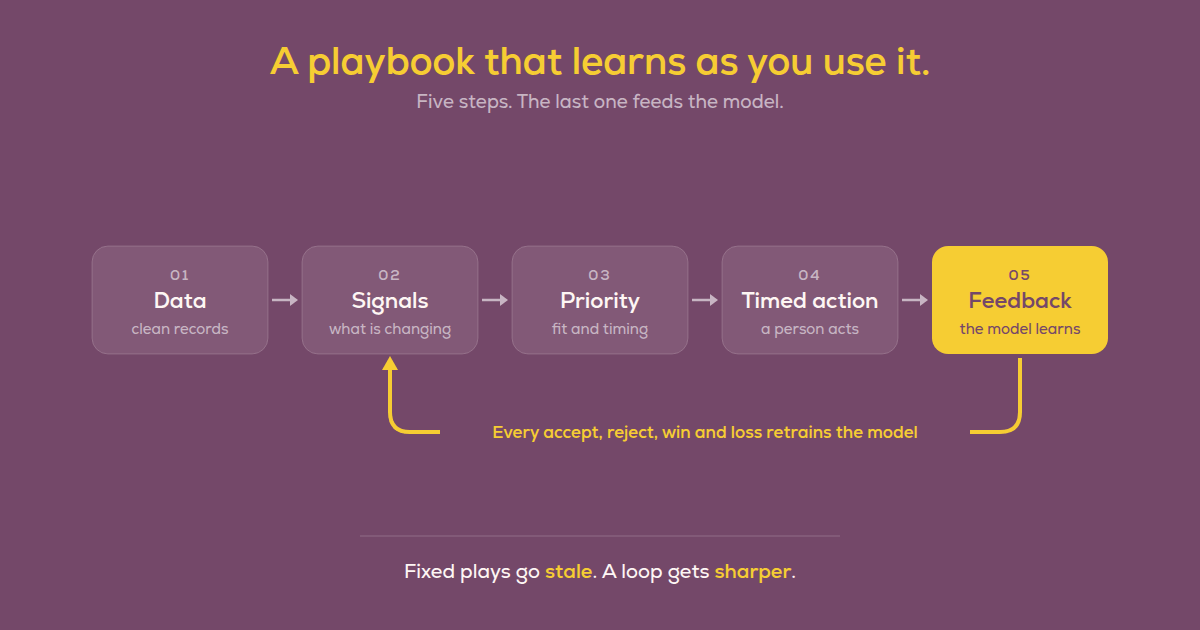
Sales process optimization means improving how your team decides which accounts to work, when to reach out, and why. Most playbooks improve the inputs and then write down a fixed set of plays. This one runs in five steps: data, signals, priority, timed action and a feedback loop. The last step is the one that matters most. What your team accepts and rejects goes back into the model, so the playbook gets better the longer you use it.
Step | The question it answers | What it needs |
|---|---|---|
1. Data | Which records can we trust? | Clean accounts, deal stages and outcomes |
2. Signals | What is happening at each account now? | Public company events |
3. Priority | Which accounts come first this week? | Fit and timing, kept apart |
4. Timed action | Who reaches out, and with what reason? | A person who owns the account |
5. Feedback | Was the ranking right? | Each accept or reject, and every won or lost deal |
Step 1: Fix the Data Only Your Team Can Fix
This is the starting point. Every following step is based on this data, so any error travels forward. A wrong record does not stay a small mistake, because a ranking repeats it at every step. But not all data is yours to maintain. Company facts such as size, industry, location and ownership change all the time. Keeping them current by hand is a job no team wins. At AxonJay, that company data is enriched for you inside the platform, from official registers and the open web.
Some data only your team can provide, and that is where sales data quality really matters. First, decide which accounts are in scope. If that is not written down yet, start by building an ideal customer profile (ICP). Second, record deal stages and outcomes the same way every time. Agree what each stage means, and why a deal counts as won or lost. This is revenue operations work, and it does not end. It matters twice, because step 5 learns from those outcomes. Inconsistent records teach the model the wrong lesson.
Step 2: Add the Predictive Signal Layer
Clean data tells you who your accounts are. It does not tell you what they are doing now. That is the job of the predictive signal layer. It watches what the companies in scope do: they hire, raise funding, open offices, change leaders, etc. From those events, it forecasts which accounts are entering a buying window before the obvious signals appear. It also shows why each one should be contacted now (the why-now).
Most signal-based playbooks work the other way round. They wait for a trigger, such as a funding round or a new executive, and then run a fixed play. A trigger is something that has already happened. A predictive layer reads the pattern that comes before it, so your team can move earlier. Our guide to signal-based selling explains the signals themselves in more detail.
At AxonJay, the AI-Signal Agents do this work. Each agent does one job on its own: it ranks accounts for a single purpose and explains the ranking. The signal layer sits on top of the stack you already run. It adds timing to your CRM, and it replaces nothing.
Step 3: Rank Accounts by Fit and Timing
Most teams already rank accounts with a score. Keep it, because a score is good at fit. It tells you which accounts belong on a rep's list and who owns them. It is bad at timing, because the number stays the same while the company changes. Our article on account prioritization shows how a score goes stale over a single quarter. So rank on two things: fit to decide who is in scope, and timing to decide the order each week.
At AxonJay, timing shows up in two ways. A Golden Moment is an account already in scope that is entering a buying window now. A Rising Star is a label on an account in scope that was quiet for a long time. Its signals have picked up, so it climbs the list, and the label tells the rep why. This is where sales productivity comes from. The team is not doing more. It spends the same hours on the accounts where something is happening. Coverage stops depending on which rep happened to notice which account.
Step 4: Take Timed Action, With a Person Behind It
A ranked list only helps if someone acts on it while the window is open. So agree who owns each account, and how soon they act when it moves up. The why-now tells the rep what to talk about. Say a company in scope announces a move into a new country and starts hiring there. The reason to call is that expansion, not a general product pitch. The rep opens with what changed at the company, and the conversation starts from something real.
The same signals work on the customers you already have. On a customer, they can point to room for expansion or to a renewal at risk. Our article on B2B churn prediction covers the second case. AxonJay does not send the message, for either kind of account. That is a choice, not a missing feature. A playbook built on timing over volume has no use for a bigger sending machine. The conversation stays with the person who owns the account. You can see how teams put this to work on our use cases and testimonials page.

Step 5: Close the Loop So the Playbook Learns
Most playbooks end with a report. The report shows what happened last quarter, and someone decides whether to change the plays. Then the playbook stays the same until the next review. The fifth step replaces that with a loop. When a rep accepts or rejects a ranked account, that decision goes back into the model. So does every deal that is won or lost.
That is what Self-Machine-Learning means in practice: the model is yours. It trains on your team's decisions and your outcomes. It is not one shared model that scores every customer's accounts the same way. Over time, it sharpens on the accounts that actually buy from you. So the ranking gets more accurate the more your team uses it. Keep your reports, because they still tell you how the quarter went. But the measurement that improves the playbook is the one the model reads. A playbook with a loop gets better because your team used it.
Frequently asked questions
What is sales process optimization?
Sales process optimization is the ongoing work of improving how a sales team finds, ranks and works its accounts. It covers the data the team relies on, the order in which accounts get worked, and the timing of each conversation. It is never finished. Markets change, so the process has to learn from its own results.
How is a signal-based playbook different from a traditional sales playbook?
A traditional playbook describes what to do: the steps, the scripts and the follow-ups. A signal-based playbook adds when: it starts a play when something happens at the account. A predictive playbook goes one step further. It forecasts which accounts are about to enter a buying window, instead of waiting for the trigger. Adding a feedback loop is what keeps any of them from going stale.
What does revenue operations own in this playbook?
Revenue operations owns the definitions. That means which accounts are in scope, what each deal stage means, and how wins and losses are recorded. It also owns the loop: making sure reps accept or reject ranked accounts, so the model keeps learning. Most of this is routine work. It matters because every other step depends on it.
Do I need clean CRM data before I can start with AxonJay?
No. AxonJay enriches the company data itself, so your first ranking does not depend on your CRM. Your own records matter later, when the model learns from your outcomes. Clean them as you go. The ranking improves as your data does.