
What an AI SDR Does, and the One Decision It Still Needs From You
By Jean-Philippe Schepens van Thiel
Sending a message is cheap. The consequences are not. The four stages of outbound, which of them an AI SDR actually owns, and the three questions to put to one before you buy.
An AI sales development representative (AI SDR) is software that does the early outbound work a junior rep used to do. It drafts the message, sends it, reads the reply, handles the first objection and books the meeting. It is good at that work and it is getting better at it. What it does not do is decide which companies are worth the attention, or which week is the right week to spend it, and those two decisions now set the ceiling on what the tool can return. This article is about where that line sits and what belongs on the other side of it.
What an AI SDR Actually Does
Strip away the category language and an AI SDR owns one stage of outbound: the part that happens after somebody has decided who to contact. It writes to a list, it responds when somebody writes back, it qualifies the ones who do, and it puts a meeting in a calendar. Tools differ in how much a person reviews before anything leaves the building, and that is a real difference worth asking about. They do not differ much in what they are for.
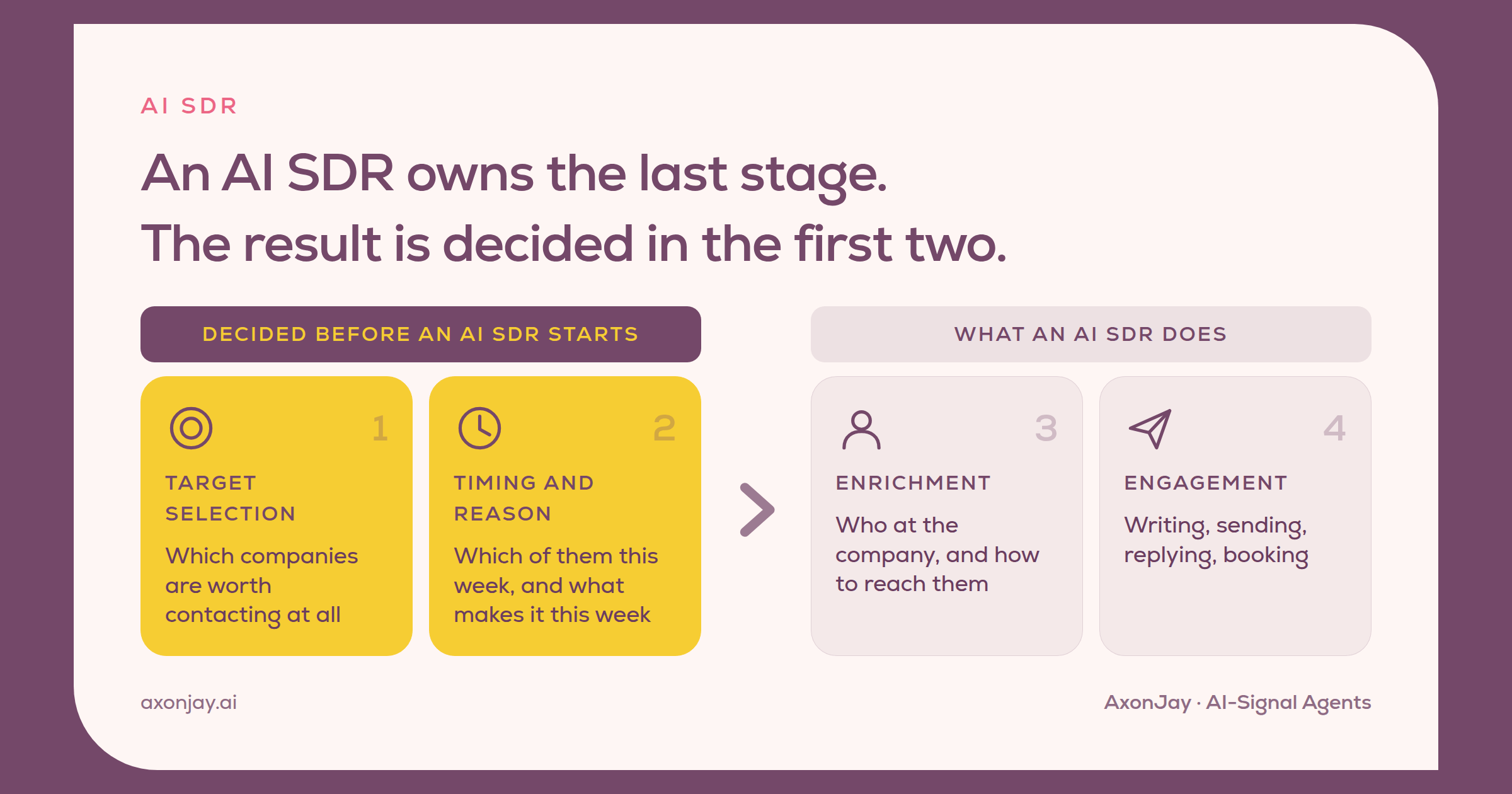
Outbound has four stages, and it helps to see them separately before deciding which of them you are buying.
Stage | What gets decided | What it costs you when it is wrong |
|---|---|---|
Target selection | Which companies are worth contacting at all | A quarter of attention spent on a list that was never going to buy |
Timing and reason | Which of them to contact this week, and what is happening that makes now the week | The message has nothing specific to point at, so it reads like every other one |
Enrichment | Who at the company, and how to reach them | You reach the wrong person, or nobody |
Engagement | Writing, sending, replying, qualifying, booking | Nothing goes out, or what goes out reads as though nobody meant it |
An AI SDR owns the fourth row and, in most tools, part of the third. The first two rows happen before it starts, and they are usually settled by whatever list somebody uploaded. That is the arrangement worth looking at closely, because the first two rows are where the result is actually decided.
Volume Stopped Being the Advantage
The reason this matters more now than it did three years ago is that the cost of a message collapsed. An AI SDR makes the next message almost free, which means every team that buys one sends more. Mailbox providers decide what reaches an inbox mostly on how a domain behaves rather than on what a message says, so as volume climbs, more of your mail is filed as spam and some of it is refused before it is ever delivered. Your own sending domain carries that, and it carries it into every campaign after this one. So the thing that used to be the advantage, more touches, is now the thing that creates the risk.
That changes which resource is scarce. It is no longer sending capacity. It is reasons worth sending about. A team with a hundred well-chosen accounts and something true to say about each one is in a better position than a team with ten thousand addresses and a faster writer, and the gap widens as everybody's volume goes up. An AI SDR working from a list of every company that matches your ideal customer profile (ICP) is doing the old thing faster, which is the one thing the new tool was supposed to stop doing.
The Decision an AI SDR Cannot Make
Target selection and timing are different questions and they get confused constantly. Matching your ICP is a static property of a company: its industry, its size, where it is, roughly what it looks like. It tells you a company could buy from you one day. It says nothing about whether this is the week. Timing is an event, not a property, and events are visible: a company hires, signs a lease, raises money, replaces an executive, opens a site, wins a contract. Reading those events in combination is what signal-based selling means, and it is a different job from filtering a database.
Here is an example of the difference. Say you sell warehouse automation. Two companies in your market match your profile exactly, same industry, same size, same region, and on any ICP filter they are indistinguishable. One has done nothing visible in eighteen months. The other has signed a lease on a second site, posted a job ad for a logistics manager and named a new operations director. An AI SDR will write to both of them, because nothing in the list it was given tells the two apart. The second company is the one with a reason to answer. The reason is also the first line of the message, which is the part an AI SDR cannot invent for itself.
Ranking is the other half of it. Once you can see which accounts are moving, you still have to decide what a rep or a tool works first, and account prioritization is a weekly question rather than a one-time setup. The point of putting it ahead of the sending is that a short list worked properly beats a long list worked fast, and the short list is the only one a person can review before it goes out.
Where a Predictive Signal Layer Fits
At AxonJay, this is the part we build. The predictive signal layer sits in front of whatever sends. It reads public company events, official registers, financial filings, news, websites and hiring activity, as listed on how it works, and forecasts which accounts are entering a buying window rather than waiting for one obvious trigger to show up. The difference between forecasting the window and reacting to a trigger is covered in more detail in our article on predictive and reactive signals.
Every account the signal layer ranks arrives with why they should be contacted now (the why-now): which events happened, when, and where we read them. In the AxonJay Self-Machine-Learning Platform™ (Self-ML), a Golden Moment is a company already in your scope that is entering a buying window now. A Rising Star is a label the platform puts on a company already in your scope that produced very few signals for a long time and has recently picked up, so it climbs the ranking and the label says why it moved.
Each of the AI-Signal Agents is specialized in ranking accounts for one purpose, and the list of purposes is longer than prospecting. The Golden Moment Agent ranks who is entering a buying window. The Upsell Agent reads the same signals across the customers you already have and ranks who is ready to buy more. The Churn Agent reads them again and ranks who is at risk of leaving. One company's hiring run can be a reason to pitch, a reason to offer more, or a reason to call ahead of the renewal, and which of the three you are shown depends on which agent is ranking.
The signal layer also learns. Every account a rep accepts or rejects goes back into the model as a thumbs up or a thumbs down. When you also hand over the deals you closed and the deals you lost, the model learns from outcomes and not only from opinions. The ranking sharpens over time on the accounts that buy from you rather than on accounts in general, which is the feedback step that makes a sales process improve with use instead of staying where it was configured.
AxonJay does not send. That is a position rather than a missing feature. Sending is a crowded, well-served part of the stack, and the predictive signal layer is more useful sitting in front of all of it: an AI SDR, a sequencing tool, or a person who would rather write their own email. Nothing is replaced, but everything downstream becomes more focused and more efficient. This is the same argument as adding an AI layer to a sales stack you already run.
Which leaves the question of where the ranking shows up, and the answer is not "in another tab". Our integration app syncs the ranked accounts and their why-now into the CRM your team already works in: HubSpot, Salesforce, Microsoft Dynamics 365, Pipedrive, Zoho CRM, Odoo or Teamleader. There is also an application programming interface (API) if you would rather send it somewhere else. The queue an AI SDR works from can be that list, with the reason already attached to every row.
What to Ask Before You Buy One
Three questions separate the tools that will help from the ones that will make your existing problem faster. First, where does the list come from, and who decides what goes on it? If the answer is an upload, the tool is only as good as the upload. Second, does every account arrive with a reason, and can you see the events behind it? A rep acts on an account they can see the reason for and skips one they cannot. Third, how many messages does the tool send on its own, with nobody reading them first, and can you change that number? This is the setting that decides how fast you spend your own sending domain. Unreviewed volume is what gets mail filed as spam and refused, and that cost lands on you rather than on the tool, in every campaign after this one. A tool with no cap, or one you cannot lower, has made that choice on your behalf. The number worth having is low, and it only stays low without costing you meetings when the list underneath it is short and picked on timing rather than on fit.
None of this is an argument against buying an AI SDR. The work it does is real, it is work nobody enjoys, and it is now cheap. It is an argument about the order. Decide who and when first, with something better than a filter, and the tool that sends is working on the right hundred accounts instead of the wrong ten thousand.
Frequently asked questions
What is an AI SDR?
An AI sales development representative is software that runs the early stage of outbound sales. It writes and sends the first messages, replies to the responses, qualifies the people who answer and books meetings. Tools vary in how much a person reviews before anything is sent. They all sit at the end of the process, after the decisions about who to contact and when have already been made somewhere else.
Will AI replace sales development representatives?
It is replacing the part of the job that is typing, and that part was already the least valuable. What it does not replace is judgment about which accounts deserve attention this week and what is worth saying to them. Those decisions move upstream rather than disappearing, which is why teams that adopt these tools well tend to spend more time on targeting and timing, not less.
How much does an AI SDR cost?
Pricing is usually per seat, per contact or per meeting booked, and the three are not comparable, so ask which one you are signing. The larger cost is usually not on the invoice. A tool priced per contact rewards you for loading more contacts, and the volume it encourages is paid for by your sending domain and by the time your team spends on accounts that were never moving.
Do AI SDRs actually work?
They work at what they do, which is producing and handling outbound at a volume no team could staff. Whether that turns into pipeline depends almost entirely on the list they are given. The same tool pointed at every company matching an ICP and pointed at accounts entering a buying window produces very different results, and the difference is decided before the tool starts.