
What Is a Buying Window? How to Tell When a B2B Account Is Ready
By Jean-Philippe Schepens van Thiel
Most of the attention goes on windows opening. This is about the rest of one: the four states an account moves through, and why the closing edge is the only part with a date attached.
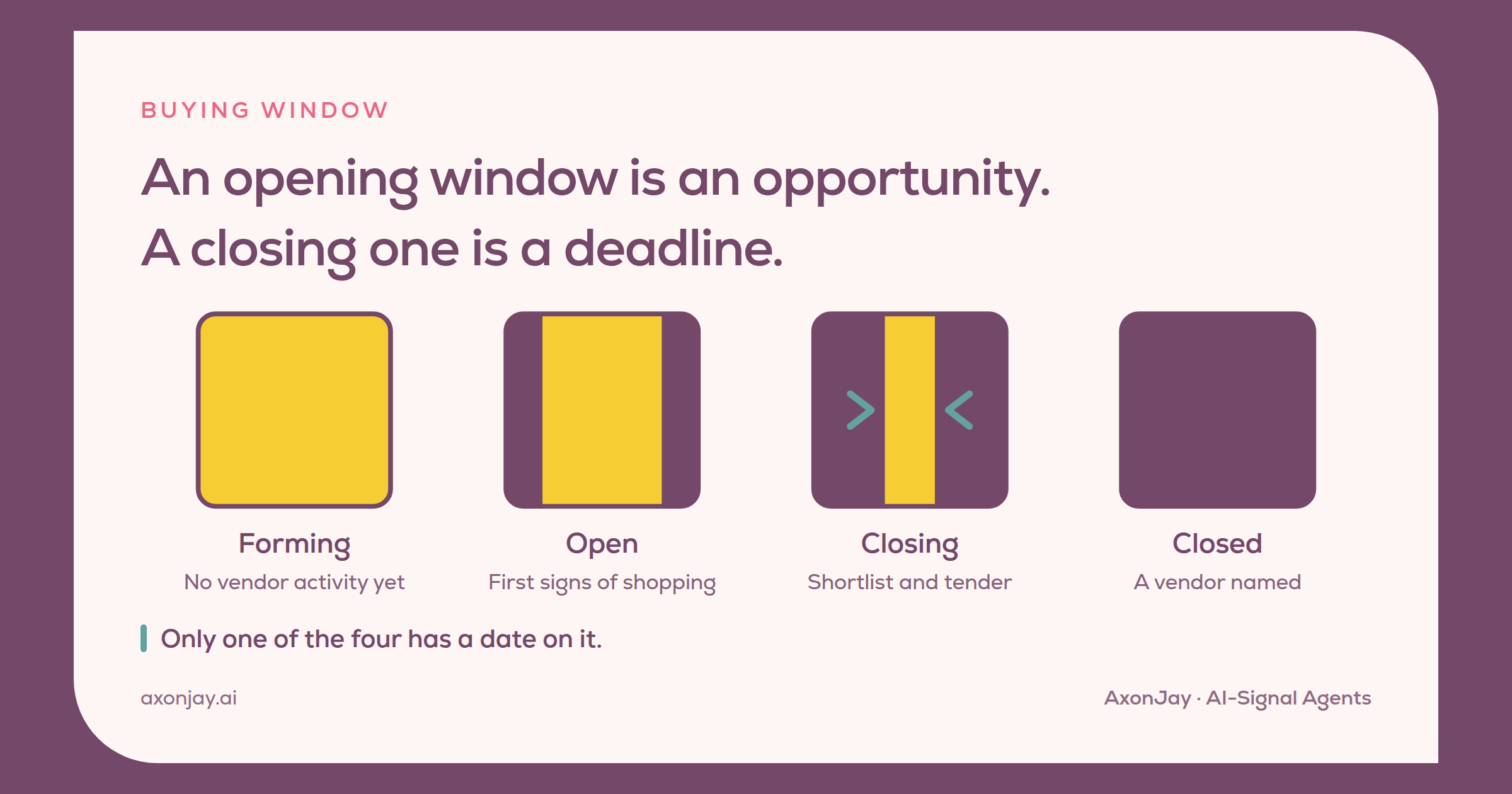
A buying window is the period in which a company has an open requirement and can still be influenced on how it is satisfied. It opens when something inside the company creates a need, and it closes when the decision is made, whether or not you were involved with it. In between, an account moves through four states: forming, open, closing and closed. Each looks different from outside the company, and the closing edge, not the opening, is the one that should change what a sales team does this week.
It is read from the order and pace of public company events, the same material behind predictive versus reactive buying signals and pre-intent. It is not a pipeline stage, not fit, and not a forecast of who wins.
The Four States of a Buying Window
A window is not a switch. It has a beginning, a middle in which it is genuinely contestable, a stretch where it is narrowing, and an end. Those four states look different from outside the company, and what you can usefully do differs in each.
State | What you can see from outside | What is still available to you |
|---|---|---|
Forming | Structural moves and no vendor activity at all: a role opened, a site or license added, a leader arriving in the function that owns the problem | The requirement itself. Nothing has been written down yet |
Open | Those moves continuing, plus the first signs of shopping: a buyer's guide downloaded, a question asked in public, an analyst called | The criteria, if you are already in the conversation when they are drafted |
Closing | A shortlist forming, reference calls, a tender published with its requirements already fixed | Competing on criteria somebody else wrote |
Closed | A vendor named, a platform announced, hiring that only makes sense after an implementation | Nothing on this requirement. The next window is the renewal |
Your own customers move through these four states too. The same public events that say a prospect is forming a requirement say it about an account you already invoice, which is where renewal and expansion windows come from. Whether you have sold to a company before makes no difference to the window: it belongs to the company's decision, not to your relationship with it.
The row that surprises teams is the second one. Open is the state usually described as in-market, and it is later than the phrase suggests: by then the requirement exists and the company has begun shopping. Reaching an account in the open state is not the same as reaching it in the forming state, and it is not the same as being in the deal. The earlier of the two is where the criteria are still yours to influence.
The Closing Edge Matters More Than the Opening
A forming window is an opportunity and a closing one is a deadline, and a deadline is the one that sets today's order of work. An opportunity can be worked next week at roughly the same odds. A closing window cannot: every day it narrows, the criteria harden further around somebody else's answer, so the cost of waiting is real and dated. That is the difference, and it is why a team that knows an account is closing acts this week while a team that only knows an account is open puts it on a list.
The closing edge is also the easier of the two to observe, because it leaves clear public traces. A company that publishes a tender with fixed requirements has told you the criteria are set. A company whose press release names a chosen platform has told you the window shut. Hiring that only makes sense once a system is already in place, an implementation manager or an administrator for a named category of tool, says the same thing, and it is on a careers page before it is anywhere in your pipeline.
Reading closed windows well has a second use, which is knowing what to stop doing. A requirement that has been decided against you is not a slow deal that still might land; the answer is already no, and the account is sitting in a forecast on the strength of a conversation that ended without anyone saying so. A deal that ages without moving may be in exactly that state, and the public record is where you could find out. Checking costs nothing, but it is less satisfying than adding accounts.
Telling Which State an Account Is In
You can identify the state of a buying window for most accounts from public facts alone. The useful question is not only which events have happened but in what order and how fast. Reading a sequence that way is the subject of pre-intent, and here it is simply the input: a run of structural moves in quick succession with no vendor activity anywhere near it is a forming window, and the same moves strung out over a year are a company going about its year. No amount of outreach will create a requirement that is not there.
Two readings are worth doing deliberately. First, look for a company that is clearly changing shape while showing no sign of shopping yet: hiring, premises or licensing on the move, and nothing that looks like vendor research. That combination is the forming state, and it is the only one in which the requirement is still yours to shape. Second, look for events that only happen late. A reference call you hear about, a tender, a named vendor: each is evidence the window has reached closing or closed, past the point where the criteria were open, and each should change the account's priority rather than its position in a sequence of follow-ups.
Here is an example. A specialty pharmacy chain is granted a license in a second state, hires a director of operations, and takes a lease on a fulfillment site, all inside about two months. That is a forming window and nobody there has searched for anything yet. Some months later the company's own announcement names the platform it will run the new sites on, which is the window closed. It was open for most of the gap between those two facts, and the only observable thing that changed at the end was a press release.
What a Buying Window Is Not
It is not a stage in your pipeline. Pipeline stages describe where a deal sits in your process; a window describes where a decision sits in the customer's. The two can sit a long way apart, and when they disagree the customer's clock is the real one.
It is not fit. An account can sit inside your ideal customer profile (ICP) for years without a window ever opening in it. Fit settles whether a company belongs in scope and is silent on when, which is why timing needs a reading of its own. Account prioritization is where the two get combined into an order of work.
It is not a forecast of who wins. A window forming says a decision is coming, not that it will go to you or that it will be made at all. Plenty of requirements form and then stall for a year.
How AxonJay Reads the Window
At AxonJay, the predictive signal layer forecasts the buying window from the order and pace of public company events, rather than reporting a single trigger once it has fired. What it gives a rep is timing and the reason to act now (the why-now), with every source behind it.
Two things in the product follow directly from the states above. A Golden Moment is an account in scope entering its window now, at the turn from forming to open, which is while the criteria are still reachable. A Rising Star is an account that was quiet for a long time and has recently started producing signals, which is usually a window beginning to form. The Golden Moment Agent is the reading built for the first of those, specialized in pinpointing the best timing and topic for outreach.
Timing is the whole product, and customers are where the case for it gets made: reaching fewer accounts at the right point in their window beats reaching more of them at any point. A test run by a customer reported 178 replies from 250 signal-timed emails, against almost nothing from 1,000 generic ones; more results and testimonials are on our site. How the layer sits beside the tools you already run is covered in AI sales agents and the tech stack.
Frequently asked questions
What is a buying window in B2B sales?
A buying window is the period during which a company has an open requirement and can still be influenced on how it is satisfied. It opens when something inside the company creates the need, usually visible from outside as hiring, new premises, licensing or a leadership change, and it closes when the decision is made. The window is a property of the customer's decision, not of your sales process.
How do you know a buying window has closed?
Look for events that only occur late. A published tender with fixed requirements, reference calls, an announcement naming a chosen platform, or hiring that only makes sense after an implementation. Each is public, and each tends to appear before a stalled deal is taken out of a forecast.
What should you do when a window is closing?
Decide whether you are still in the running, and act on the answer rather than on hope. If you are, the remaining room is on criteria you did not write, so the useful move is addressing those criteria directly instead of restating your case. If you are not, the account is not a slow deal: the answer is already no and nobody has told you. The honest step is taking it out of the forecast and watching for the next window, which is usually the renewal of whatever was just bought.
What is the difference between a buying window and buying intent?
Buying intent is evidence that a company is researching a category, usually a single event read on its own. A buying window is the whole period in which the requirement is open, from the first structural moves until the decision. Intent normally appears once the window is already open, after the requirement has been framed, which is why it arrives late for shaping the criteria.
Do your existing customers have buying windows?
Yes, and they are read from the same public events. A customer adding a site, a function or a leader is forming a requirement in exactly the way a prospect does, and the fact that you already invoice them changes nothing about the signal. Treating windows as a prospecting idea is what leaves renewal and expansion to a calendar date instead of to what the account is actually doing. The same reading is what B2B churn prediction is built on.