
AI Lead Scoring: What Goes Into a Score, and What It Cannot Tell You
By Jean-Philippe Schepens van Thiel
Two accounts at the same number are not the same conversation. The three inputs behind a score, the half that should make it fall, and what the number will never tell you.
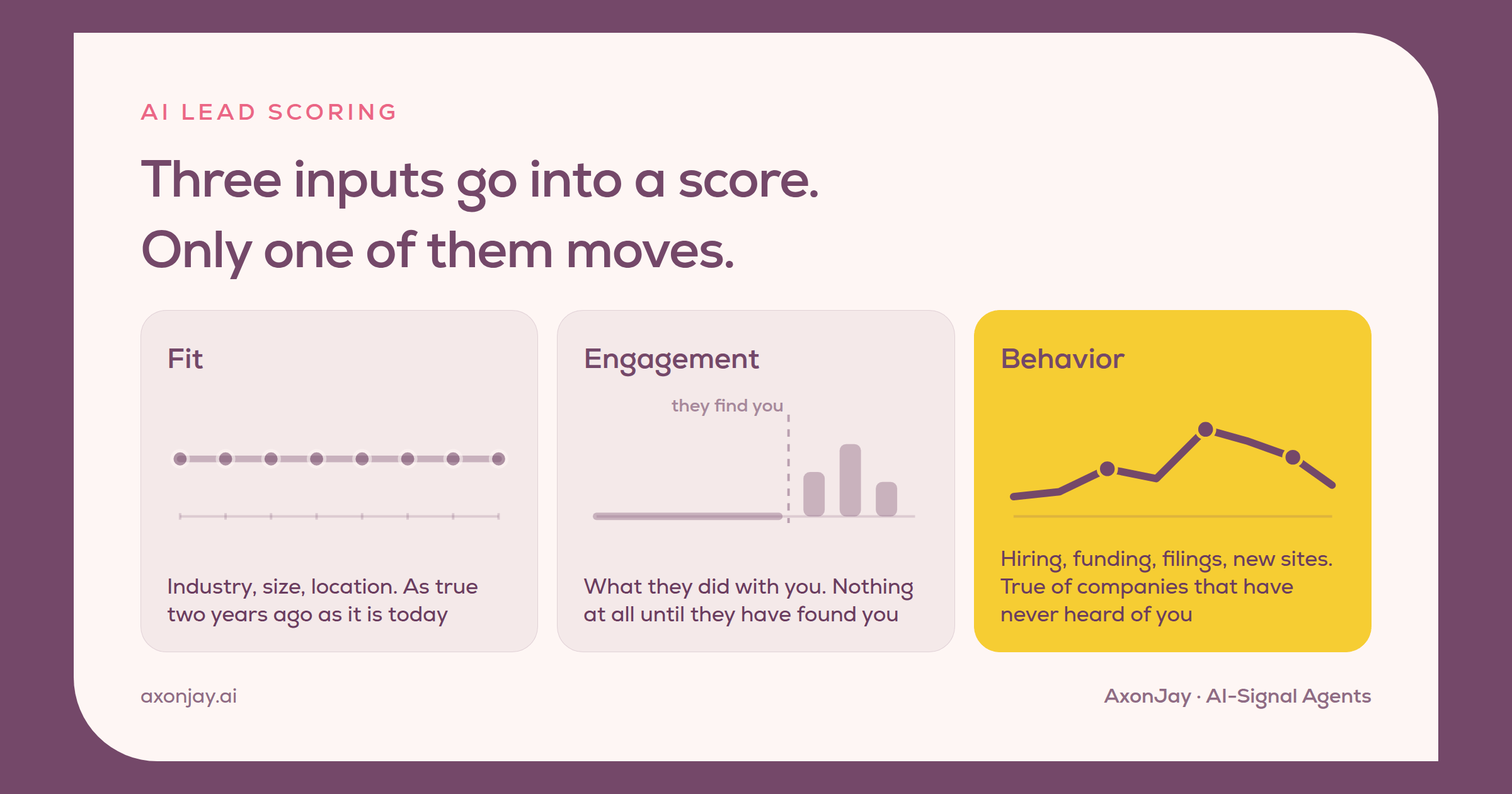
An AI lead score is one number that ranks accounts by how likely they are to buy, and it is built from three different kinds of input: how well a company fits your profile, how it has engaged with you, and what it has been doing out in the world. Those three behave nothing like each other, and most arguments about whether scoring works come from not separating them. The number has exactly one job, which is to put the list in order. It cannot tell you why an account moved, who to speak to there, or what to open with, and a team that expects those things from a number stops opening it within a quarter and goes back to working the list the way it did before.
The Three Things a Score Is Made Of
Fit is the static half, and it is your ideal customer profile (ICP) turned into a number. Industry, size, location, technology, revenue band: the properties that say a company belongs in your market at all. Fit is also the half that does not change. A manufacturer with four hundred staff fits your profile this morning exactly as well as it did two years ago, which means a score built mostly on fit produces the same ranking every week. That is not a model. It is a filter with a number printed on it, and it is the most common reason a scoring project quietly stops being opened.
Engagement is what the account has done with you: pages visited, emails opened, a form filled in, a webinar attended. It is genuinely informative and it has one structural limit, which is that it only exists for companies that have already found you. The accounts you most want to reach are usually the ones with no engagement history at all, so a score weighted toward engagement ranks your inbound list very well and your market very poorly.
Behavior is what the company does in public, whether or not it has ever heard of you: hiring, funding, filings, new premises, leadership changes, contracts won. This is the half that actually moves, and reading it in combination rather than one trigger at a time is what signal-based selling means. It is also the only one of the three that can be true of a company that has never visited your website.
One more distinction worth making early, because the word "lead" hides it. Most scoring products score a person: a job title, an email address, what that person clicked. What a revenue team usually needs to decide is whether to work the company this week. Those are different questions, and a tool that answers the first will not answer the second however good its model is.
What Moves a Score Up, and What Moves It Down
The second column is the one most descriptions leave out, and it is the half that tells you whether a score is a model or a filter.
Moves it up | Moves it down |
|---|---|
Hiring into the function that owns the problem you solve | A hiring freeze, or a long quiet stretch after a burst of activity |
A funding round, a new site, a lease, a permit, an acquisition | Nothing new since the last time the account was ranked |
A new executive arriving in the buying function | The executive who was driving the change leaving |
A contract or tender win that implies a project you fit | A project completing, which closes the window rather than opening it |
Your team accepting and working accounts that look like this one | Your team rejecting accounts like this one, repeatedly |
Two things follow from that table. The first is that a score should fall on its own. If nothing has happened at an account for a long time, its number should drift down without anybody editing a rule, and if it does not, the ranking is slowly filling with companies that were interesting once. The second is that the bottom row is not like the others. The first four rows are things the market does. The last is something your team does, and whether a score listens to it is the difference between a model that sharpens on your market and one that stays exactly as accurate as it was on day one.
A Score Ranks. It Does Not Explain.
Here is the problem with a number, in one example. Two accounts come back at the same score. The first is a company that fits your profile well and has been quietly reading your pricing page for three weeks. The second barely fits, but it has just leased a second site and posted three roles in operations. The number says they are equal. They are not remotely the same conversation, and no amount of model accuracy fixes that, because the information a rep needs was thrown away at the moment the inputs were collapsed into a single figure.
So the useful output is the number and the reason: which events happened, when, and where they were read. That is why they should be contacted now, the why-now, and it is the part a rep can actually use on a call. It is also what makes a ranking believable internally. People act on an account when they can see why it moved and skip one when they cannot, whatever the number says.
Two things a score will never do, and it is worth saying them plainly. It cannot tell you who to speak to at the account, because that is contact data and a different job. And the number itself cannot tell you what to say, although the events behind it usually can. Working the ranked list once you have it is its own discipline, covered in account prioritization.
Four Questions to Ask of Any Score
What is it made of, and in what proportion? Ask for the split between fit, engagement and behavior. If it is mostly fit, you have a filter. If it is mostly engagement, you have an inbound tool, which may be exactly what you want as long as nobody expects it to find new accounts.
What makes it move, and does it fall by itself? A score that only ever goes up is not reading anything. Ask what causes a decrease and how long an account keeps a high number after the activity behind it stops.
Does every account arrive with its reason attached? Not a category or a confidence label, but the events, the dates and the sources, so a rep can open them before calling. Ask to see a ranked list rather than a description of one. A vendor that can show you the reasons will, and one that shows you a number and a color band is telling you what it has.
Is this score built for us, or does everyone get the same one? A single shared model scores your accounts the same way it scores every other customer's. Ask what happens to accuracy after your team has accepted and rejected a few hundred accounts, and whether your won and lost deals are part of it.
Where Our Ranking Comes From
At AxonJay, the ranking is produced by the predictive signal layer, and it sits almost entirely on the third input above. It reads public company events, official registers, financial filings, news and hiring activity, as listed on how it works, and forecasts which accounts are entering a buying window rather than waiting for one unmistakable trigger. The distinction between forecasting the window and reacting after the fact is set out in our article on predictive and reactive signals.
Each of the agents is specialized in ranking accounts for one purpose, and the Golden Moment Agent is the one that answers the timing question: the moment an account is most receptive, and the topic to raise. Every ranked account carries the why-now, so the reason travels with the number instead of being discarded by it.
In the AxonJay Self-Machine-Learning Platform™ (Self-ML), a Golden Moment is a company already in your scope entering a buying window now. A Rising Star is a label the platform puts on a company already in your scope that produced very few signals for a long time and has recently picked up, so it climbs and the label says what moved.
The signal layer learns from your team. Every account a rep accepts or rejects goes back into the model as a thumbs up or a thumbs down, and if you can also hand over which deals you closed and which you lost, those go in the same way. That is the bottom row of the table doing its work. The gain shows up downstream rather than in the score itself: a shorter list worked on timing means fewer touches spent on accounts that were never going to answer this quarter, which is the whole argument for optimizing the sales process around the feedback loop instead of around volume. The same reading applies to companies you already sell to, where the same events can mean room to expand or a renewal worth protecting, as our article on B2B churn prediction sets out. Nothing in your stack is replaced: the layer orders the list, and whatever you already use to reach people keeps that job, including an AI sales development representative, which is a separate category and a separate question.
That matters for where the ranking ends up. A score that lives in a tool nobody opens on a Tuesday does not change the week, however good it is. Our integration app syncs the ranked accounts and the why-now behind each one into the CRM your team already works in: HubSpot, Salesforce, Microsoft Dynamics 365, Pipedrive, Zoho CRM, Odoo or Teamleader. The reason then arrives in the same place as the call, and the ranking is also available through an application programming interface (API) if you would rather put it somewhere else.
A score is worth having. It is worth having for what it is, which is an ordering, and it earns its place when the reason behind it survives all the way to the person making the call.
Frequently asked questions
What is AI lead scoring?
It is the use of a model, rather than hand-written scoring criteria, to rank prospects by how likely they are to buy now. The model is trained on what happened before, which accounts converted and which did not, and works out for itself which inputs matter instead of being told. The inputs are usually some mix of fit, engagement with you, and what the company has been doing publicly.
How is AI lead scoring different from rule-based scoring?
Rule-based scoring uses points somebody chose: a corporate email address is worth this much, a pricing page visit that much. It is transparent and it only knows what its author believed when they wrote it. A rule set is also static. It stays exactly as written until somebody sits down and rewrites it, which in most teams happens far less often than the market moves. A model derives the weights from outcomes and keeps changing them as outcomes change, so every accept, reject, win and loss moves it. The honest trade is that a rule is easy to explain and quietly goes out of date, while a model is harder to explain and has to be made to show its reasons.
Should I score leads or accounts?
Score accounts if your sale involves more than one person, which in business-to-business it nearly always does. A lead score tells you about an individual and their behavior, which is a question for whatever your marketing team already runs. An account score tells you whether the company is moving, which is the question that decides whether this is the week to work it. AxonJay rates companies and not people, because the buying window belongs to the company rather than to whoever happened to fill in a form.
Why does a good score stop working?
Usually because it never falls. If a score only accumulates, accounts that were busy a year ago keep their place at the top and the list slowly stops matching reality. The other common cause is that it was built mostly on fit, so it produces the same ranking every week and the team learns there is no reason to look again.